 by Tealyra
Teapot for Loose Tea: The Buyer’s Guide
Find the perfect teapot for loose tea. Compare materials, sizes, and infuser types to brew better tea at home with confidence and clarity.
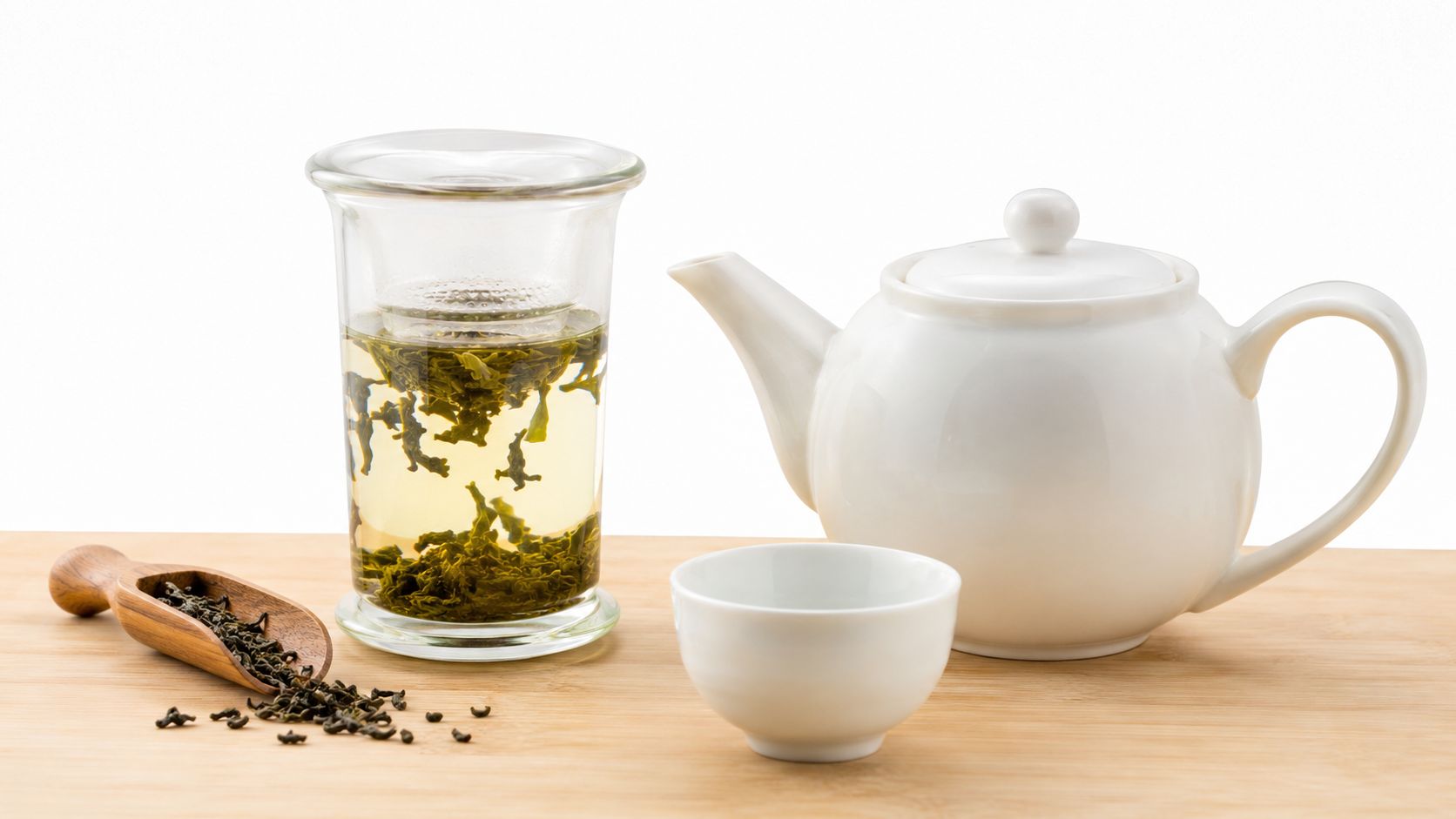
Loose-leaf tea can be more expressive than tea bags, but have you ever considered that your teapot might be changing the flavor before you take the first sip? The leaves need room to open, water needs to move through them, and temperature needs to remain steady enough for the infusion to develop without becoming harsh.
A good teapot for loose tea is more than a pretty container. It controls the relationship between heat, water, leaf movement, and time. Once you understand those four factors, choosing between ceramic, glass, cast iron, stainless steel, and different infuser designs becomes much easier.
Table of Contents
- Why the Right Teapot Changes Everything
- Matching Teapot Materials to Your Brewing Style
- Choosing the Perfect Infuser and Strainer
- Determining the Ideal Size for Your Needs
- Common Mistakes to Avoid When Buying
- Caring for Your Teapot and Maintaining Quality
Why the Right Teapot Changes Everything
A tea bag usually keeps a small amount of finely cut tea in a compact pouch. It's convenient, but the leaves have limited space to expand and circulate. Loose tea gives you a different starting point. Larger leaves, rolled oolongs, whole herbs, and blended ingredients need room to move through the water, and a cramped mug infuser can prevent that from happening evenly.
Consider a common morning routine. You add loose tea to a small metal ball, place it in a mug, and pour in hot water. The outside leaves receive water first, while the tightly packed center stays relatively dry. The result may taste weak at first, then suddenly astringent when you leave the infuser in longer. A spacious teapot basket changes the pattern by allowing water to reach more of the leaf surface at once.
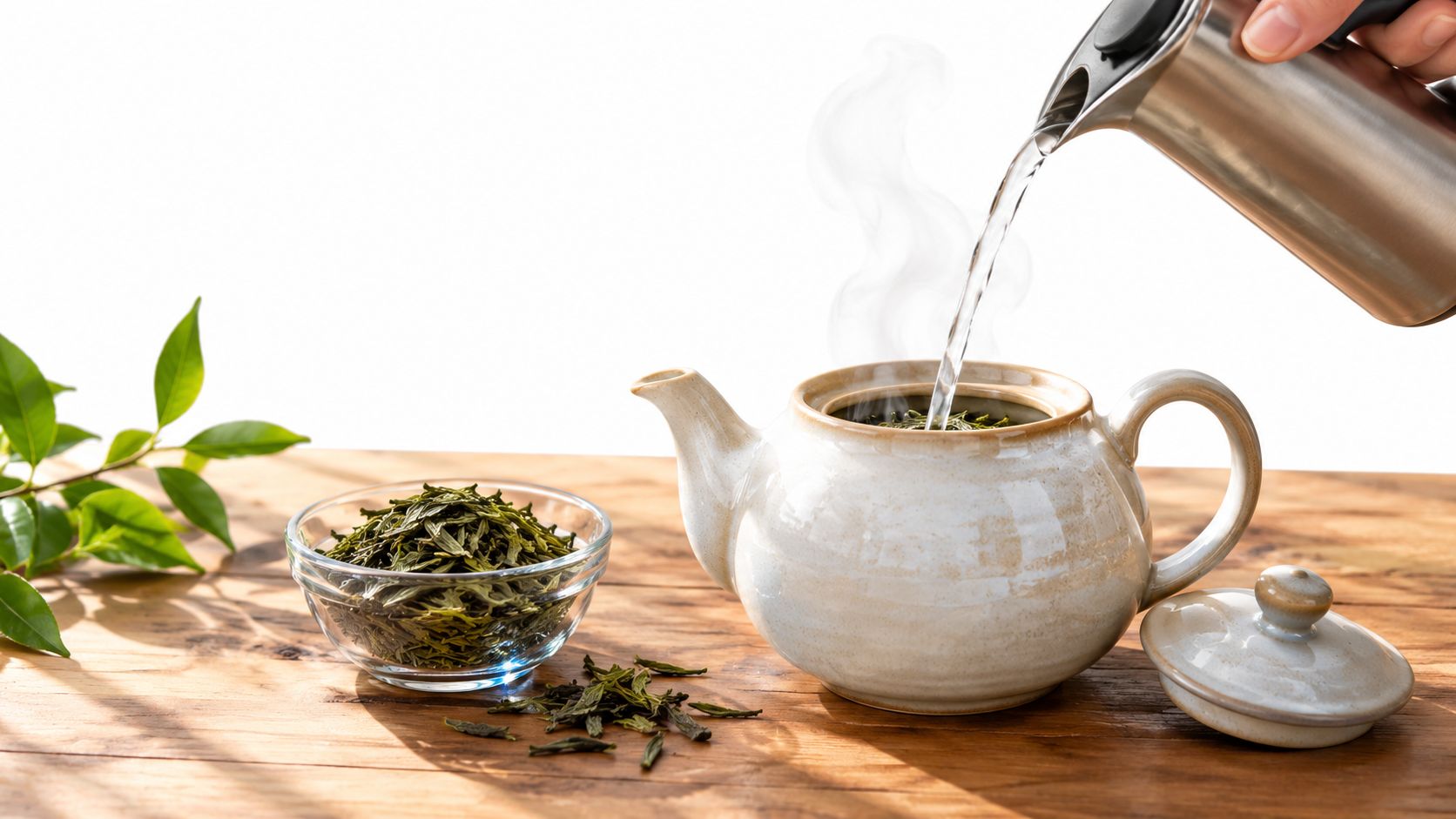
Steeping is not the same as brewing
“Steeping” often means leaving tea in hot water and hoping the timing works. Brewing is more deliberate. You select a vessel that supports the leaf, use an infuser that permits circulation, and choose a material that behaves well with the style of tea you drink.
The pot acts like a small thermal environment. If it loses heat quickly, the water can cool before the leaves finish releasing their flavor. If it holds heat for longer, the infusion can continue under steadier conditions. Research on teapot materials describes porcelain and ceramic, along with cast iron, as better at retaining heat, while glass cools more quickly. This comparison of teapot materials and thermal performance is useful when you're deciding whether visual control or temperature stability matters more to your routine.
Practical rule: Choose the pot around the way you drink tea, not around the way an empty pot looks on a shelf.
That distinction matters most with loose leaves that can be brewed more than once. A roomy vessel lets the leaves open, while a removable basket lets you stop the infusion cleanly instead of leaving the leaves submerged in increasingly strong water. You may also find that the same tea tastes different in a thick ceramic pot than in a thin glass one, even when you use the same leaves and water.
Tea preparation has always responded to the shape and behavior of the vessel. The Victoria and Albert Museum's history of teapots describes how the modern teapot developed as tea preparation moved from compressed cakes and powdered tea toward loose leaves steeped in hot water. That history helps explain why a dedicated pot isn't an unnecessary extra. Its shape evolved alongside the brewing method.
If you're setting up tea at work or designing a shared refreshment area, practical hot-water planning also matters. A guide to workplace tea and coffee hot-water units from Ring Hot Water can help you think about the kettle or hot-water source separately from the brewing vessel. At home, the same principle applies: hot water is only the beginning, and the pot determines how that water behaves around the leaves.
For a deeper look at how material choices relate to tea styles, the guide to tea varieties and teapot materials offers useful background. The key takeaway is simple: loose tea rewards equipment that gives the leaves space and gives you control.
Matching Teapot Materials to Your Brewing Style
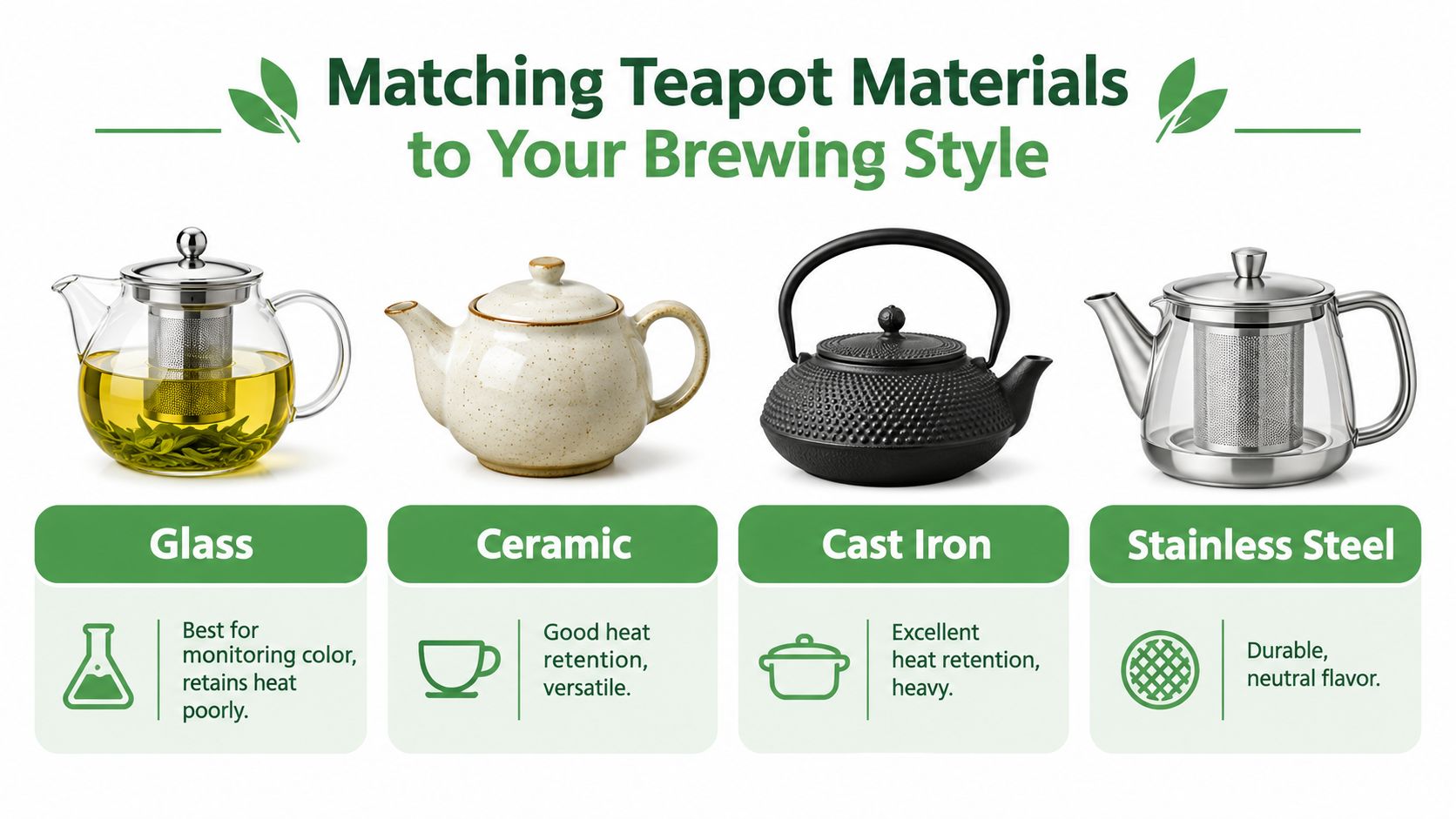
Material affects the speed at which a teapot gains, holds, and loses heat. That doesn't mean one material is universally superior. It means each one creates a different brewing environment, and the right choice depends on whether you value prolonged warmth, visual feedback, or a lightweight daily routine.
Porcelain and ceramic are practical starting points for many tea drinkers. They retain heat longer than glass and work across a broad range of loose teas. A thick-walled ceramic pot can keep the infusion warm while you pour several servings, making it a sensible choice for a relaxed morning or a shared pot.
Cast iron takes heat retention further. Its weight can be an advantage when you're brewing a strong black tea or a dark oolong and want the pot to remain warm during a longer session. The tradeoff is equally clear: cast iron is heavy, takes more effort to handle, and needs attentive drying so its surface stays in good condition.
Borosilicate glass offers a different kind of control. It cools faster, but you can watch the water change color and see rolled leaves unfold. That makes it useful for short sessions where you want to judge the infusion visually and serve it soon after brewing. The same thermal behavior that helps delicate, immediately served tea can become inconvenient if you expect the pot to hold warmth for a long conversation.
Think in brewing situations
Rather than asking which material is best, ask what tends to go wrong in your current routine.
| Your brewing priority | A sensible material direction | Why it fits |
|---|---|---|
| You want to observe leaf expansion and color | Borosilicate glass | The transparent body gives immediate visual feedback, but heat leaves the vessel faster |
| You want a versatile everyday pot | Ceramic or porcelain | These materials provide steadier warmth across varied loose teas |
| You serve tea slowly or prefer a hot pot | Cast iron | It holds heat strongly, though its weight and care requirements are higher |
| You want a durable, straightforward vessel | Stainless steel | It is practical for frequent use and pairs well with a separate infuser |
The choice also depends on how you stop an infusion. A removable basket lets you take the leaves out while keeping the brewed tea in the warm vessel. With a built-in filter that can't be removed, the tea may continue extracting as it sits. That can be fine if you pour immediately, but less convenient if several people are drinking at different speeds.
Match heat behavior to the leaf
A delicate green tea may benefit from a vessel that doesn't hold intense heat for too long, especially when you serve it promptly. A dark oolong or full-bodied black tea may feel easier to manage in ceramic or cast iron because the water stays warmer during the session. These are not rigid rules. Water temperature, leaf quantity, steeping time, and personal taste still matter.
Material also influences your maintenance habits. Glass shows residue clearly, ceramic can develop stains, and cast iron needs the most careful drying. Stainless steel is often chosen for durability and practical cleaning. Your best purchase is the one whose care requirements you'll follow.
The reported comparison of ceramic, porcelain, cast iron, and glass teapot performance supports this heat-based approach. Don't buy a material only because it suggests a particular tea tradition. Buy it because its thermal behavior suits the way you pour, pause, serve, and re-steep.
Choosing the Perfect Infuser and Strainer
What should an infuser do besides hold loose tea? It controls how water moves through the leaves, how fully they can expand, and how much fine material reaches your cup. That makes it part of the brewing system, not a decorative insert. A well-made teapot can still produce flat, harsh, or gritty tea if its infuser restricts the leaves or interrupts circulation.
Start with the basket shape. A wide, deep basket gives large leaves and rolled oolongs room to open, much like giving a sponge enough space to absorb water. A narrow ball infuser compresses the leaves and reduces the area that touches moving water. Tea balls remain useful for compact brewing, but they suit smaller leaves better than teas that need substantial expansion.
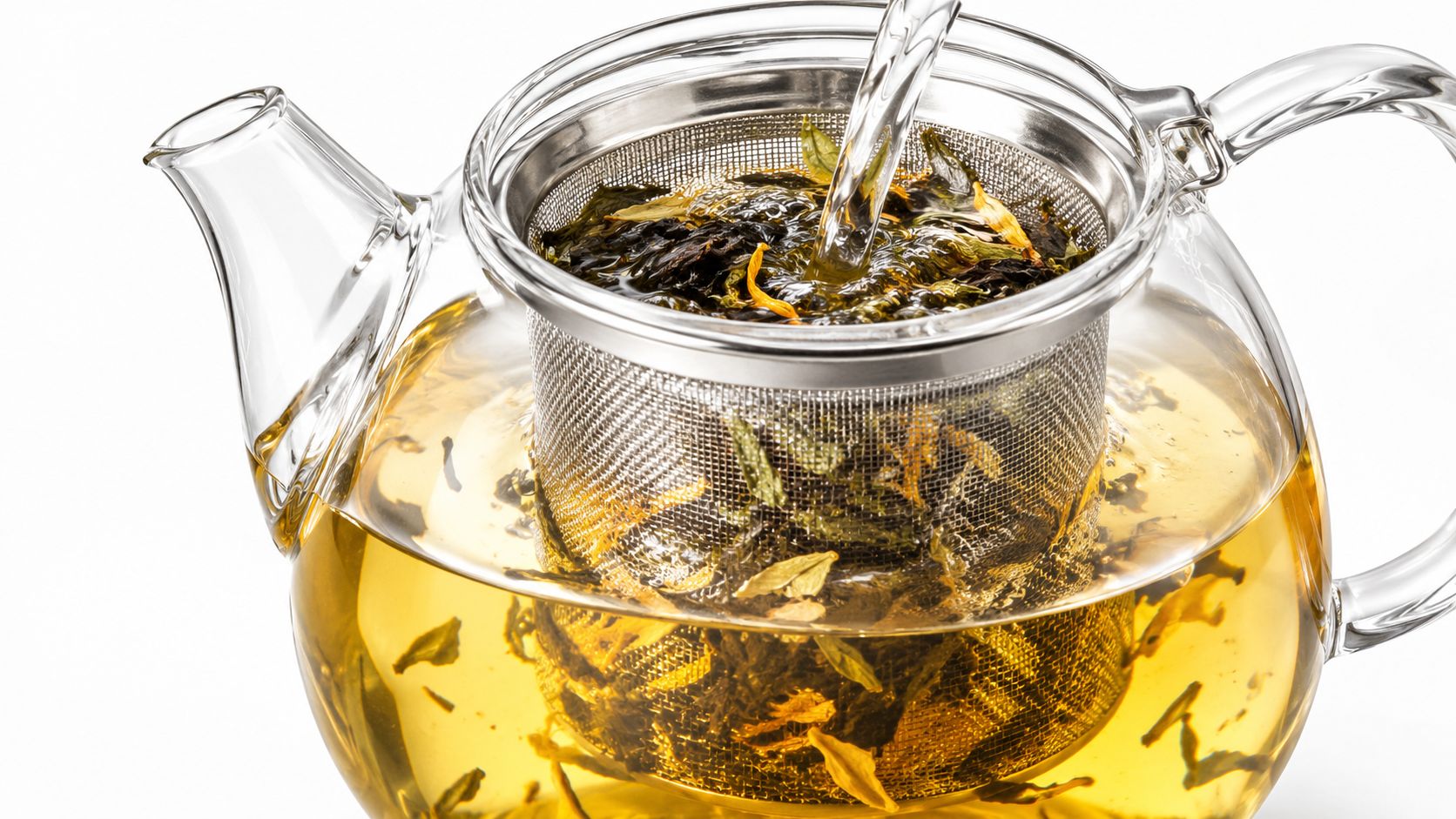
Mesh size controls clarity and flow
Fine-mesh stainless steel works well for many loose teas. Practical guidance commonly places suitable apertures around 0.3 to 0.5 millimeters, while mesh near 100 microns can catch much smaller particles for a cleaner cup. Guidance on choosing strainer baskets and infusers explains the trade-off: mesh that is too restrictive can slow convection and interfere with extraction.
Convection is the circulation pattern inside the pot. Hot water rises, cooler water moves around it, and that movement carries liquid through the leaves. Open space around the basket helps this process continue naturally. When mesh or basket walls block too much flow, some leaves may receive less fresh water than others, producing an uneven cup even though every leaf is submerged.
Very fine mesh suits finely broken leaves, herbal blends with small particles, or drinkers who strongly dislike sediment. The finest filter available is not automatically the right choice. The basket should keep unwanted fragments out while still allowing water to pass freely, like a window screen that blocks insects without blocking the breeze.
A filter should hold the leaves, not imprison them.
Compare the main infuser formats
- Wide removable basket: Flexible for large leaves, repeated infusions, and quick removal.
- Fine-mesh basket: Useful for small fragments when the mesh still permits steady water flow.
- Ball infuser: Compact and convenient, though its limited space can crowd the leaves.
- Separate strainer: Lets leaves move freely in the pot, then filters the tea only during pouring.
A separate strainer can suit households that brew many types of tea. Large oolong leaves, fine black tea, herbal pieces, and blended ingredients have different space and filtration needs. Simply Hospitality's infusion teapot shows how a removable infusion component can make the pot easier to adapt, empty, and clean between brews.
A compact setup can also include an EasyTea infuser accessory alongside a standard teapot. Test the physical design before judging its appearance. Can you reach the basket? Can you lift it without spilling or dripping? Does its mesh match the leaves you usually buy? These answers affect daily brewing more than the pattern on the pot.
Use this troubleshooting guide when the cup does not taste right:
| What you notice | Likely infuser issue | What to change |
|---|---|---|
| Weak flavor despite enough leaf | Basket is cramped or water flow is poor | Use a wider basket with more open space |
| Sediment in the cup | Mesh openings are too large | Choose a finer mesh or pour through a separate strainer |
| Bitter flavor after a short time | Leaves remain in the water or circulation is uneven | Remove the basket promptly and inspect the mesh |
| Rolled leaves stay tightly closed | Infuser is too small | Move to a deep, spacious basket |
Determining the Ideal Size for Your Needs
Capacity should follow your routine, not your imagination of an elegant tea service. A small pot may work beautifully for one person who drinks a single serving immediately. It becomes frustrating if you refill it repeatedly, while a large vessel can leave a solo drinker warming more tea than they need.
Use this simple framework before you shop.
Start with your normal session
First, describe a typical tea moment in practical terms. Do you make one serving before work, drink several small pours across an afternoon, or prepare a pot for everyone at the table? Count the cups you serve rather than the cups you wish you served.
Next, consider whether the leaves stay in the pot. If you remove the infuser and pour gradually, a larger pot can work well for sharing. If you leave the leaves submerged, a smaller serving vessel may give you better control because the tea won't sit in contact with the water for as long.
Add your household pattern
A useful sizing decision includes three questions:
- How many people usually drink at once? A solo drinker needs a different format from a household that shares tea after meals.
- Do you re-steep the same leaves? If yes, choose a pot whose basket is easy to remove and refill with fresh hot water.
- Where will the pot live? Check the cabinet, sink, warming surface, and serving tray. A pot you can't comfortably wash or store will become a nuisance.
A compact glass model such as the Pyxis glass teapot may suit a drinker who values visibility and a manageable countertop footprint. The right capacity isn't about maximizing volume. It's about reducing wasted water, repeated reheating, awkward pouring, and leftover tea that no longer tastes as fresh.
Choose the smallest pot that comfortably serves your usual session, then size up only for a regular hosting habit.
Don't confuse the pot's stated capacity with the amount you'll pour into cups. The lid, infuser, and safe filling space occupy part of the interior, so a vessel filled to the rim isn't always comfortable to carry or pour. Leave enough room for the leaves to move and for the lid to remain secure when you tilt the pot.
Common Mistakes to Avoid When Buying
The most expensive teapot isn't automatically the most useful one. Price can reflect decoration, craftsmanship, rarity, or materials, but none of those guarantees a clean pour, accessible infuser, or easy maintenance.
Start with the spout. A narrow spout may offer control, but it shouldn't dribble down the side after you stop pouring. Look at the lid next. It should sit securely when you tilt the pot and should be easy to lift without touching a hot surface.
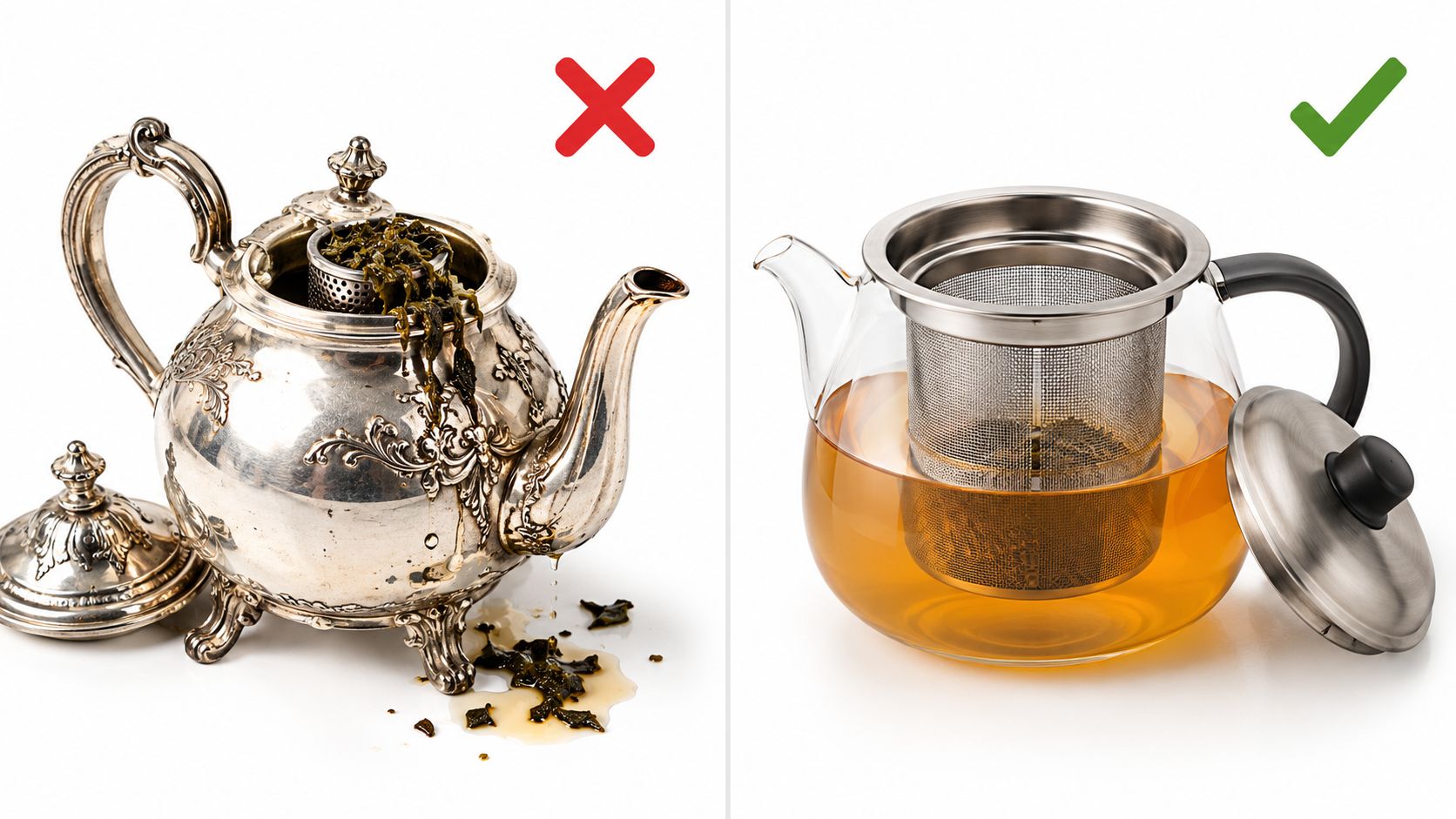
Inspect the working parts
A buyer can check most important details before making a decision:
- Infuser access: Can you remove the basket without fishing around with a spoon?
- Opening size: Can your hand or a soft brush reach the interior?
- Lid fit: Does the lid stay in place when you pour?
- Spout behavior: Does the design direct tea into the cup instead of down the pot?
- Handle comfort: Can you lift the vessel safely when it's full?
- Material limits: Does the manufacturer explain whether the pot can handle the intended heat source?
Decorative silver, patterned ceramic, and sculptural shapes can be appealing, but function should decide whether the piece belongs in daily rotation. A pot with a tiny opening may look refined and still be difficult to clean. An integrated infuser may appear convenient but become impractical if you can't remove it when the tea reaches the desired strength.
Don't overlook cleaning
Tea residue builds up in places you can't see easily, especially around fine mesh and narrow spouts. If cleaning requires specialized tools after every use, you'll be tempted to leave the pot unused or rinse it poorly. A removable stainless steel basket often makes the daily routine more straightforward, while a simple open interior makes it easier to inspect the vessel.
Also consider the surface around your brewing area. A pot that pours cleanly protects the table, tray, and saucer from repeated drips. This sounds minor until you serve tea every day. Small design decisions become important through repetition.
A good purchase balances thermal behavior, leaf space, pouring control, and care requirements. Beauty still matters, but it should support the ritual rather than force you to work around the object.
Caring for Your Teapot and Maintaining Quality
Care begins immediately after the last pour. Empty the leaves, rinse the infuser, and remove residue before it dries onto the mesh. Let the pot and basket dry fully with the lid off or slightly separated, so trapped moisture doesn't linger inside.
Different materials need different habits. Glass and ceramic can show mineral film or tea staining, so gentle cleaning is preferable to aggressive scrubbing. Cast iron deserves particular care. Don't treat its interior like an ordinary saucepan, and don't leave water sitting inside it. Follow the maker's instructions, dry it thoroughly, and protect the surface from prolonged moisture.
Stainless steel is convenient for frequent use, but its fine mesh still needs attention. Rinse from both sides when possible, check that particles haven't lodged in the openings, and use a soft brush rather than a tool that could distort the basket.
Use this final purchase checklist
- Heat behavior: Does the material suit short servings or longer warmth?
- Leaf room: Can your largest regular leaves expand without crowding?
- Mesh control: Does the infuser balance clarity with free water movement?
- Removal: Can you stop the infusion cleanly?
- Cleaning: Can you reach every surface without special equipment?
- Daily fit: Does the size suit your household, storage, and serving habits?
- Longevity: Will you maintain the material properly over time?
A durable teapot supports a lower-waste routine because you can use it repeatedly instead of relying on disposable brewing components. Market coverage has connected growing interest in herbal, green, functional, and eco-friendly tea products with stronger attention to sustainable packaging and ethical sourcing, while reporting that global tea consumption reached 6.5 million tonnes in 2022 and had grown by roughly 3.3% annually over the previous decade. This tea-market overview provides that broader context.
The best vessel is the one that makes good brewing repeatable. When the material, basket, capacity, and cleaning routine all fit your habits, the pot stops being decoration and becomes a reliable part of your tea practice.
Tealyra offers loose tea, tea bags, and tea accessories for different brewing routines, including equipment suited to preparing loose leaves at home. Visit Tealyra to compare tea and teaware options, then choose a setup that gives your leaves room, stable control, and an easy daily ritual.