 by Tealyra
1–10 Minute Tea Steeping Times: Chart and 30 Second Adjustment Rules
Compact kettle friendly 1–10 minute chart with study backed rules for brewing. Start low, taste, and adjust in 30 second steps. Cold brew and resteep tips.
White tea wants 1 to 3 minutes at 170 to 185°F, green tea the same window at 160 to 185°F, oolong 2 to 5 minutes at 185 to 205°F, black tea 3 to 5 minutes at 195 to 212°F, pu-erh 2 to 5 minutes near boiling, and herbal or rooibos blends 5 to 10 minutes at a full 212°F. Start at the low end of your tea’s range, taste, then adjust in 30-second steps until the cup suits you. Bagged tea usually needs about a minute less than loose leaf, and cold brew works on an entirely different clock, measured in hours, not minutes.
TL;DR:
- Using slightly lower temperatures than the starting range often produces better flavor and avoids bitterness, especially for delicate green and white teas.
- Bagged teas typically require about one minute less than loose leaf versions due to smaller leaf particles that release flavor faster.
- Pu-erh benefits from a quick rinse and is best steeped in 2 to 3 minutes, with multiple infusions totaling four to eight steeps.
- Longer steep times or hotter water are appropriate mainly for herbal and rooibos blends, which tolerate full boiling and extended steeping without bitterness.
- Taste-testing and gradual adjustments are more reliable than strict adherence to preset times, as leaf quality, water source, and vessel all influence flavor.
Table of Contents
- Your master chart for temperature and time by tea type
- Getting the details right for each tea type
- Why particle size changes your steep time
- Cold brew and the hot-plus-ice shortcut
- How to get more than one good cup from the same leaves
- Fixing bitter, weak, or flat tea
- What the research says about steeping and extraction
- What years of tasting have taught us about steeping
- Ready to put these steeping times into practice
- Sources
- FAQ
Your master chart for temperature and time by tea type
Keep this near the kettle. It covers the starting point for each major category, and every number here matches Healthline’s steeping guidelines, so you can trust it as a baseline rather than a guess.
| Tea type | Water temperature | Starting steep time | Good resteeps |
|---|---|---|---|
| White | 170 to 185°F | 1 to 3 minutes | 2 to 3 |
| Green | 160 to 185°F | 1 to 3 minutes | 2 to 3 |
| Oolong (rolled) | 185 to 205°F | 2 to 5 minutes | 4 to 8 |
| Oolong (open leaf) | 185 to 205°F | 2 to 4 minutes | 2 to 3 |
| Black | 195 to 212°F | 3 to 5 minutes | 1 to 2 |
| Pu-erh | 195 to 212°F | 2 to 5 minutes | 4 to 8 |
| Herbal | 212°F | 5 to 10 minutes | 1 |
| Rooibos | 212°F | 5 to 7 minutes | 1 to 2 |
| Matcha | 160 to 175°F | whisked, not steeped | not applicable |
A few notes make this chart more useful in practice. Pu-erh benefits from a quick rinse, a five-second flash with hot water, which you pour off before the actual steep, waking up the compressed leaves. Matcha is not steeped at all since the whole leaf is whisked into the water, so temperature matters more than timing, and water hotter than 175°F tends to scorch the powder into a bitter, grassy taste.
If you’re using bagged tea instead of loose leaf, steep for a shorter time than the loose leaf range, as bagged tea brews faster. Bags are typically filled with smaller leaf particles that release flavor faster, a point worth keeping in mind as you move through the rest of this guide. The resteep column reflects how many infusions typically still taste good, not how many technically contain flavor. Oolong and pu-erh reward patience here, while most herbal blends are a one-and-done affair.
Getting the details right for each tea type
White tea looks delicate but can be forgiving. Its buds and young leaves are unrolled and minimally processed, so they often need the full 3 minutes to unfurl and release their flavor, especially with silver needle or white peony styles. A correctly brewed cup runs pale gold, smells faintly of hay or melon, and tastes soft rather than sharp. If it turns bitter, your water was almost certainly too hot.
Green tea is the most temperature-sensitive category you’ll brew. Sencha and dragon well both suffer badly above 185°F, turning grassy and astringent within a minute of oversteeping. Keep water on the cooler side of the range, closer to 160 to 170°F for delicate Japanese styles, and taste at the two-minute mark before deciding whether to push further. Most bitterness complaints about green tea trace back to water that’s simply too hot, not to steeping too long.
Oolong spans the widest range of any category because it spans the widest range of processing. Rolled, ball-style oolongs like Tie Guan Yin unfurl slowly, so a Western-style steep of 3 to 5 minutes barely scratches the surface, which is why gongfu brewing, using more leaf and many short infusions of 10 to 30 seconds each, suits them so well. Open-leaf oolongs behave more like black tea and steep faster. Either way, taste at the two-minute mark: oolong should smell floral or roasted depending on style, never sharp or tannic.
Black tea tolerates near-boiling water better than any other true tea, which makes it forgiving for busy mornings. Blended breakfast teas and stronger Assams can handle the full 5 minutes without turning harsh, while more delicate single-origin black teas like Darjeeling do better closer to 3 minutes. If you take milk or sugar, you can lean toward the longer end of the range since dairy and sweetness mute some of the tannic edge that a long steep produces.
Pu-erh rewards a little ritual. After the rinse, loose-leaf pu-erh steeps in 2 to 3 minutes for the first infusion, while compressed cakes need to be broken apart gently and may take slightly longer to open up. This is a tea built for multiple infusions, often 4 to 8 steeps from the same leaves, each one slightly different as the compressed layers unfurl.
Herbal and rooibos blends are technically not tea at all since they contain no Camellia sinensis, which is part of why they tolerate full boiling water and long steeps without turning bitter. Chamomile and rooibos both do well at the full 5 to 7 minutes, while dense root and bark botanicals like the chamomile, rooibos, and ginger blends favored for gentler wellness routines can benefit from pushing toward the 10-minute mark to fully extract their flavor.
Why particle size changes your steep time
Tea leaves release flavor through their cut edges and torn surfaces, not through their intact leaf body, so smaller pieces expose more surface area to water and extract faster. That’s the entire reason bagged tea, often made from fannings and dust rather than whole leaves, needs less time than its loose-leaf counterpart.
- Subtract about a minute from any loose-leaf time when brewing the equivalent bagged tea.
- Taste broken-leaf blends a little earlier than whole-leaf versions of the same tea.
- Give leaves room to expand: a cramped infuser stalls extraction no matter how long you wait.
- Increase your leaf quantity slightly if you’re using a large teapot instead of a single infuser basket, so the ratio of leaf to water stays consistent.
A roomy infuser or a simple teapot without a basket at all lets leaves unfurl fully, which is part of why loose leaf often tastes fuller than the same tea in a cramped bag.
Cold brew and the hot-plus-ice shortcut
Cold brewing tea in the refrigerator typically takes several hours, using more leaf than for hot steeping, in a covered pitcher to keep out refrigerator odors. The result tends to be smoother and less bitter, since cold water extracts fewer tannins even as it pulls out flavor compounds over that long contact time, according to research on alternative steeping methods.
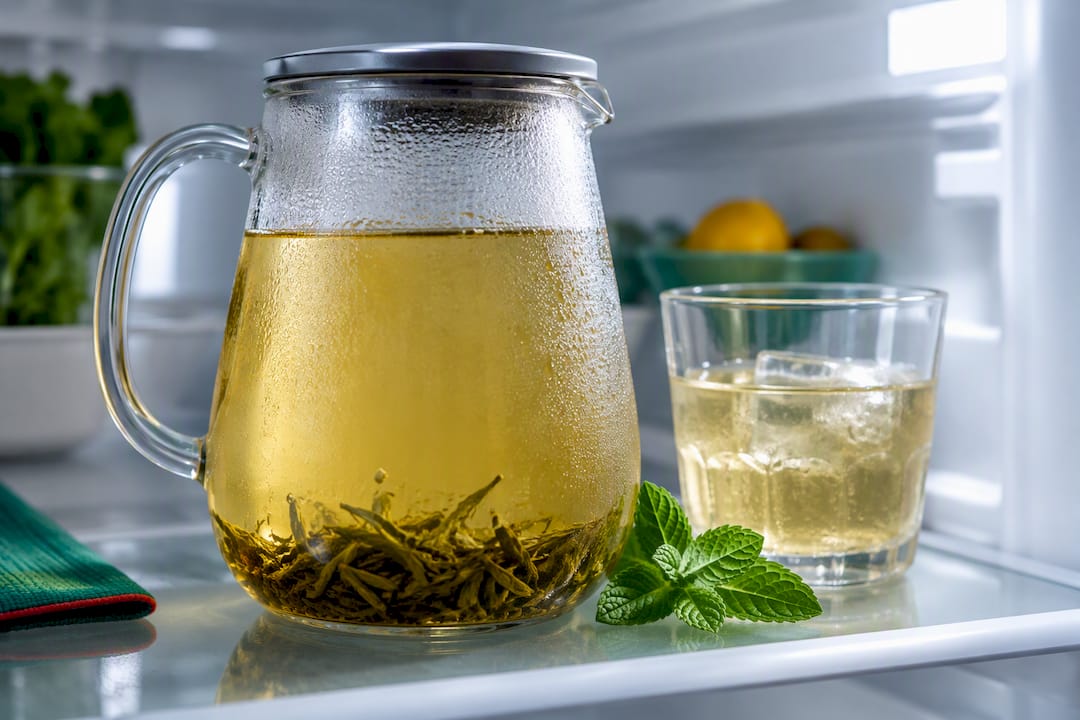
If you don’t have half a day to wait, the hot-plus-ice method gets you close in minutes. Steep your leaves hot and slightly stronger than usual for about half the normal time, then pour the concentrated tea directly over a full glass of ice. The same research found this shortcut can preserve, and in some cases increase, certain antioxidant levels compared with a hot-only steep, while still delivering the smoother profile people want from iced tea.
How to get more than one good cup from the same leaves
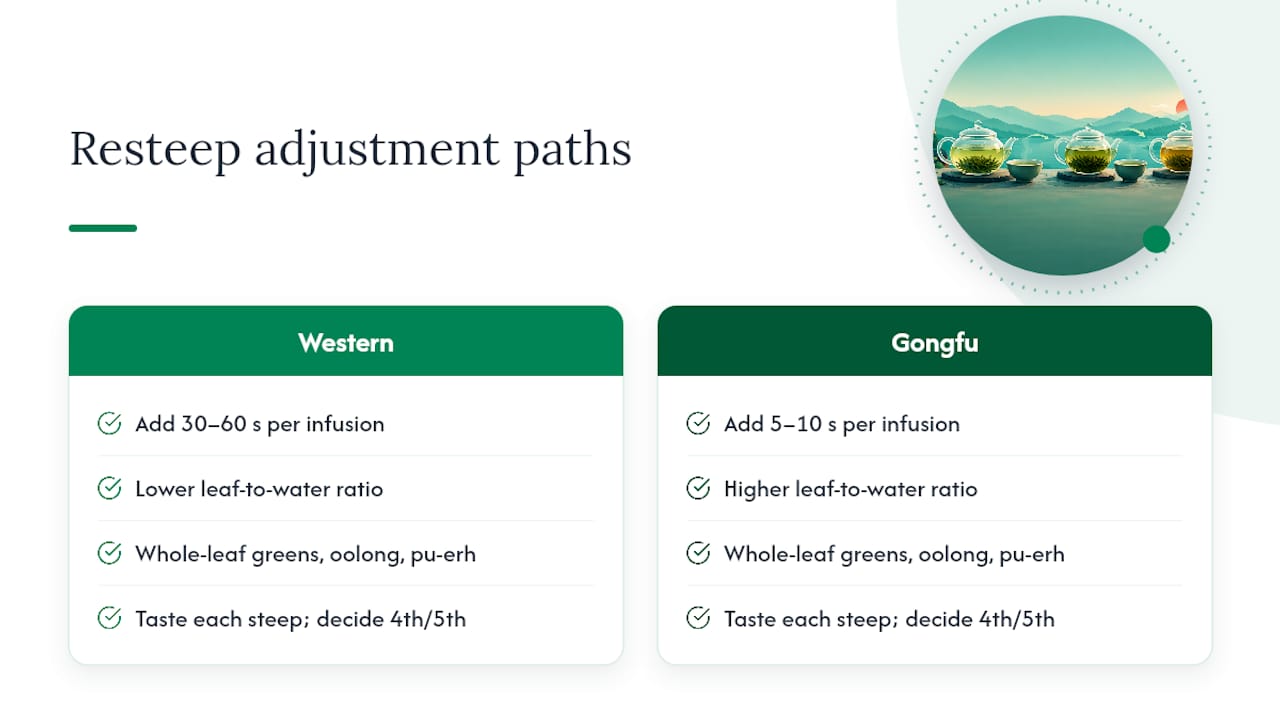
Oolong, pu-erh, and many whole-leaf greens are suitable for multiple infusions as the leaves gradually open, while most herbal blends are best steeped once.
For Western-style resteeping, add 30 to 60 seconds to each subsequent infusion since the leaves have less to give each time. Gongfu brewing works in smaller increments, adding just 5 to 10 seconds per steep since the ratio of leaf to water is already much higher. Keep a mental note, or a quick tally on your phone, of how many steeps you’re on and taste each one before deciding whether a fourth or fifth infusion is worth the leaves.
Fixing bitter, weak, or flat tea
Most tea problems trace back to one of four causes, and all four are easy to fix once you know what to look for.
- Bitterness usually means your water was too hot or your steep ran too long for that tea type.
- Weak or flat flavor often points to too little leaf for the amount of water, or water that wasn’t hot enough to extract properly.
- Flat aroma can mean you left the lid off while steeping, letting the volatile compounds that carry scent escape.
- Off flavors sometimes come down to the water itself. Filtered, fresh water makes a noticeable difference over water that’s been sitting in the kettle for days.
Pro Tip: When a cup tastes bitter, lower your water temperature by 10 to 15 degrees before you touch the timer. Time adjustments alone often just trade one flaw for another.
What the research says about steeping and extraction
The science backs up the “start low, taste, then adjust” approach more directly than you might expect. A study on polyphenol content across different steep times found that most extractable polyphenols, the compounds behind both flavor and much of tea’s antioxidant capacity, are released within the first five minutes of steeping, with only diminishing returns after that point. In other words, that fifth minute isn’t doing nearly as much work as the first one.
Temperature plays its own separate role. Hotter water extracts tannins faster, which is what produces the dry, mouth-puckering bitterness in an oversteeped or over-hot cup, while cooler water pulls out flavor more gradually and gently. That’s the whole reason a green tea steeped at 212°F turns harsh in under two minutes while the same leaves at 170°F stay smooth for three. Time and temperature aren’t independent variables. They’re a pair, and adjusting one usually means rethinking the other.
What years of tasting have taught us about steeping
The single best habit any tea drinker can build is starting at the low end of a range and adjusting from there, rather than guessing at the middle. Every leaf batch, water source, and cup size shifts the outcome slightly, so the chart is a starting point, not a rulebook carved in stone.
Trying several loose-leaf varieties side by side is the fastest way to feel these differences rather than just read about them. Keep notes on what you brewed and for how long. Your own palate will fill in the gaps faster than any chart can.
— Tealyra
Ready to put these steeping times into practice
The fastest way to learn steeping by feel rather than by chart is to have a few different loose-leaf teas on hand to compare side by side.
Tealyra’s loose leaf tea selection covers everything from delicate whites to bold pu-erhs, so you can test today’s ranges against your own taste as you go.
- Browse loose-leaf teas by category to find a few worth comparing this week.
- Free shipping is often available, making trying a handful of new varieties an easy call.
- Start with small quantities of a few types rather than committing to one large bag.
Sources
- Effects of alternative steeping methods on composition, antioxidant property and colour of green, black and oolong tea infusions — PMC
- Influence of Steep Time on Polyphenol Content and Antioxidant Capacity of Black, Green, Rooibos, and Herbal Teas — MDPI
- How to Steep Tea Like an Expert — Healthline
FAQ
Is steeping tea too long unhealthy?
Oversteeped tea is not considered unhealthy, but it does extract more tannins and caffeine, which can make the cup taste harsh and feel heavier on an empty stomach. The bigger issue is usually taste rather than safety.
What are common tea steeping mistakes?
The most frequent mistakes are using water that’s too hot for delicate teas like green and white, steeping too long without tasting along the way, and using too little leaf for the amount of water. Leaving the lid off during steeping is another overlooked mistake that lets aroma escape before it reaches your cup.
Do you steep tea with the lid on or off?
Covering your cup or teapot while steeping helps trap the volatile aromatic compounds that carry much of a tea’s scent and flavor. This matters most for delicate teas like green and white, where aroma makes up a large part of the overall experience.
Is 10 minutes too long to steep tea?
For most true teas, green, white, oolong, black, and pu-erh, 10 minutes is too long and will pull out excess tannins, producing a bitter, astringent cup. Herbal and rooibos blends are the exception, since they tolerate the full 5 to 10 minute range without turning bitter.