 by Tealyra
Matcha Powder Whisk Guide for the Perfect Froth
Master your matcha powder whisk technique. Learn how to choose, use, and care for a traditional chasen, plus explore modern electric frothing alternatives.
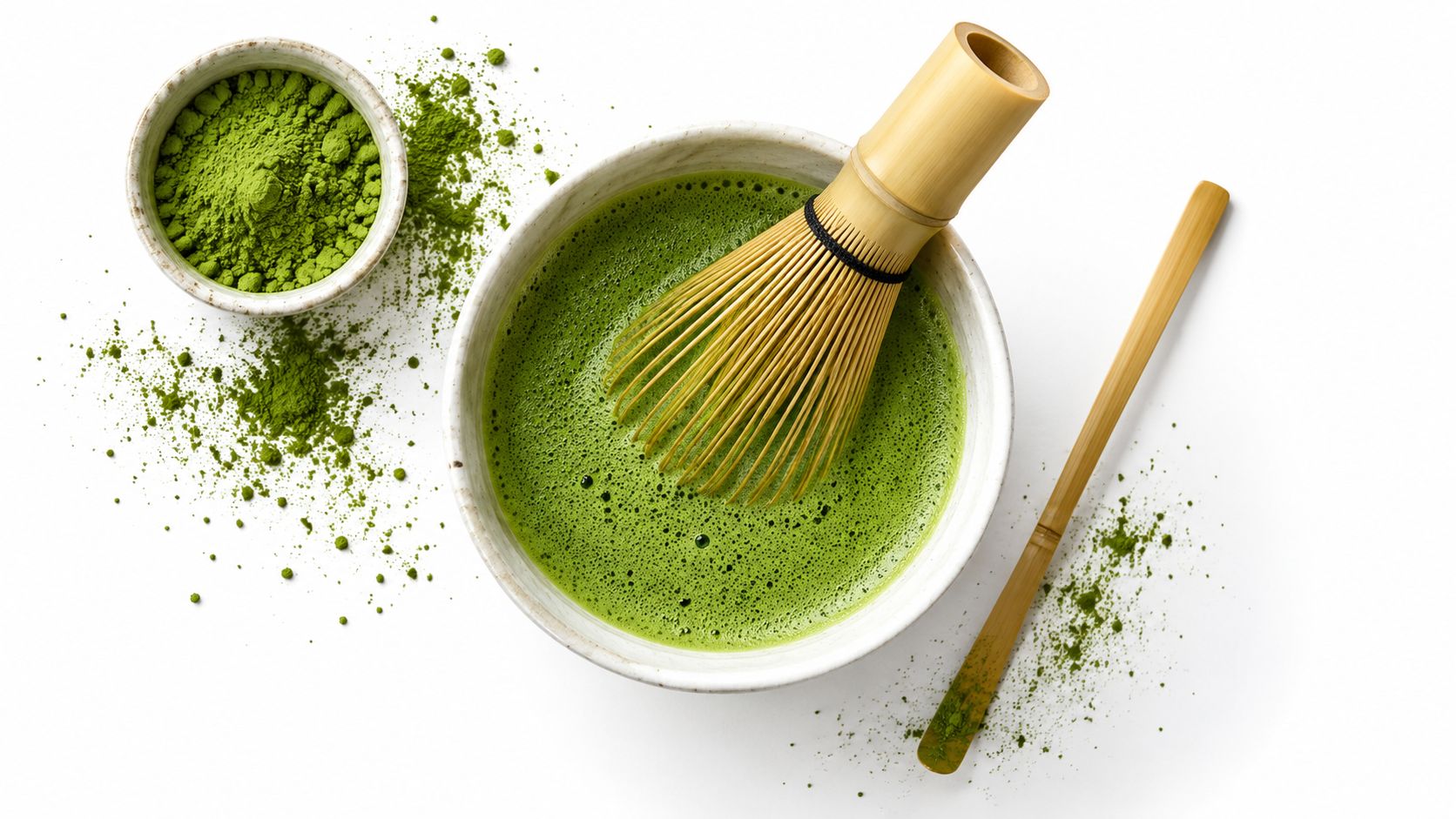
You've sifted your matcha, added warm water, and whisked with determination. Yet the drink still has stubborn green clumps at the bottom, a gritty mouthfeel, and barely any foam. It's easy to blame the powder, but the more likely problem is the tool and the way it moves through the bowl.
A matcha powder whisk is not just a smaller kitchen whisk. The traditional bamboo chasen is shaped to disperse finely milled tea, suspend the particles in water, and draw air into the mixture. Once you understand how its tines work, choosing and using one becomes much less mysterious.
Table of Contents
- Why the Right Matcha Powder Whisk Matters
- Understanding the Anatomy of a Traditional Chasen
- How to Choose the Best Matcha Whisk for Your Style
- Mastering the Technique for the Perfect Froth
- Caring for Your Bamboo Whisk to Extend Its Life
- Exploring Electric and Alternative Frothing Tools
Why the Right Matcha Powder Whisk Matters
Matcha behaves differently from loose-leaf tea. You're not steeping leaves and removing them. You're suspending powdered tea directly in water, so every clump that survives the mixing process remains in your cup. A spoon can move the liquid, but it doesn't create the fine, rapid agitation needed to separate the powder evenly.
That's why a beginner may decide that a matcha tastes poor when the underlying issue is preparation. A clump can trap dry powder inside it, leaving one sip thin and another intensely bitter. A proper chasen breaks that powder apart while incorporating air, giving the drink a more even texture and a soft layer of foam.
Practical rule: If your matcha tastes gritty, improve dispersion before assuming you need a different powder.
The tool also carries a long history. The chasen has roots in tea preparation traditions that began in Song Dynasty China and were adapted in Japan during the Muromachi period, from 1336 to 1573. A commonly cited milestone places the first true bamboo chasen in the late 15th century in Takayama, Nara Prefecture, where the craft became closely associated with chanoyu, the Japanese tea ceremony. The history of the chasen and its Takayama tradition shows how a highly specialized tool developed around the physical demands of powdered tea.
Takayama has remained a center of chasen production for more than 500 years, and one source states that the region produces about 90% of all chasen made in Japan. The village was once home to more than 50 chasen-making families, a sign of how concentrated and skilled this craft became.
The whisk remains relevant because matcha preparation has moved far beyond formal ceremony. Market research places the worldwide matcha market at roughly USD 5.1 billion in 2025, with projections ranging from USD 8.9 billion by 2033 to USD 11.9 billion by 2036, depending on methodology, as reported in this overview of the chasen's history and modern relevance. In a home kitchen, the chasen is the bridge between a delicate powder and a smooth, lively drink.
Understanding the Anatomy of a Traditional Chasen
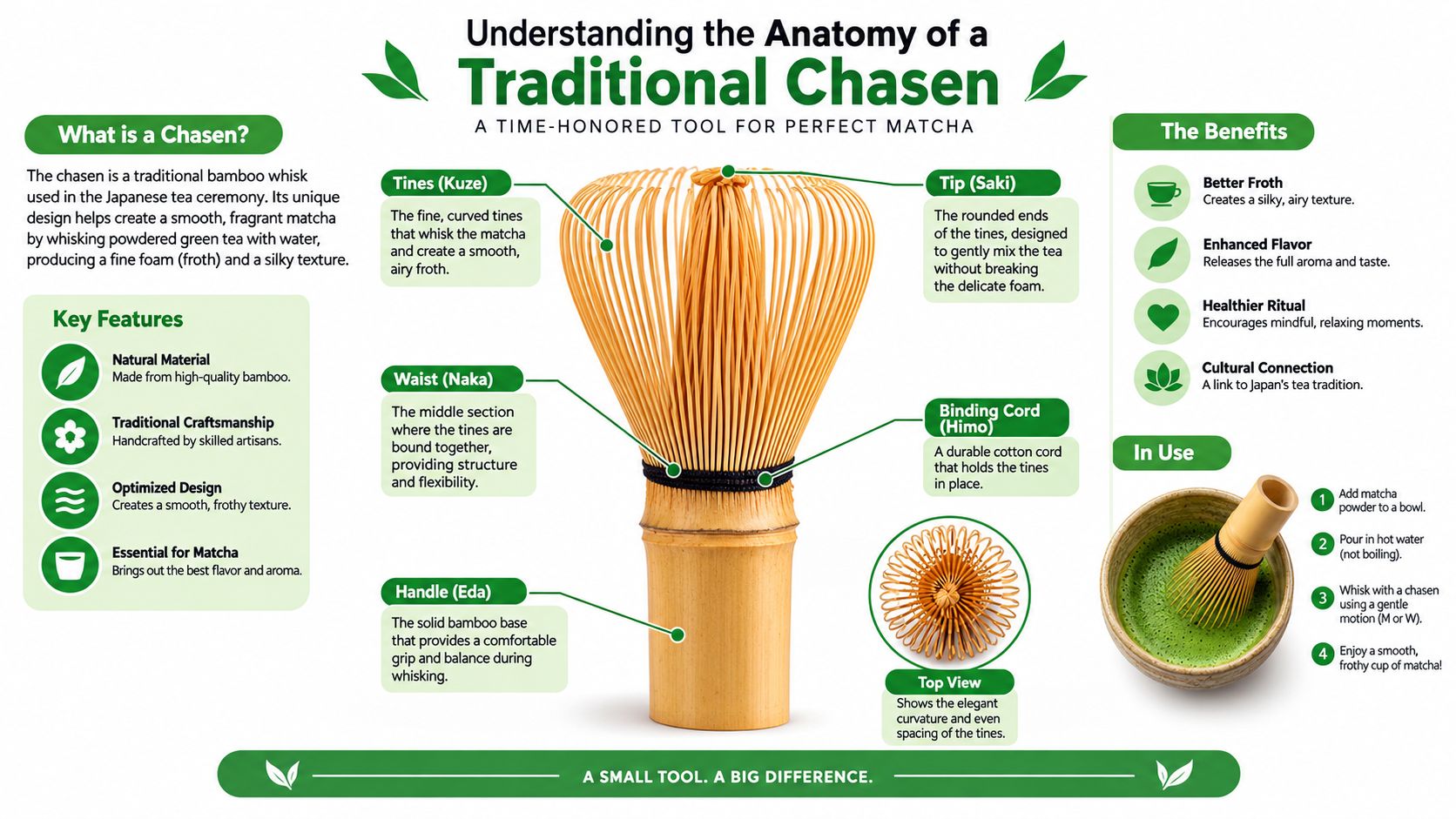
A traditional chasen is made from a single piece of bamboo that has been split into many narrow prongs, often called tines. The outer bamboo supports the handle, while the split inner section forms the flexible working end. These prongs curve inward and then spread through the liquid as you whisk.
That geometry creates several useful actions at once. The tines move through the water in many narrow paths, strike and separate powder particles, and pull air below the surface. A spoon mainly pushes liquid around one broad edge. A metal whisk may introduce air, but its wires aren't shaped to work gently inside a shallow tea bowl, and they can feel too aggressive against the bowl's surface.
Why particle size changes the result
The most important connection is between the flexibility of the tines and the size of the matcha particles. Ceremonial matcha is commonly milled to about 5–10 microns, small enough to suspend well but still prone to clumping unless high-shear whisking disperses it. This technical guide to matcha whisking and particle suspension explains why the powder needs more than simple stirring.
When flexible tines move rapidly through the mixture, they increase the number of contacts between liquid and powder. Those contacts break apart clusters and help distribute the particles throughout the water. The same motion catches air, producing the fine bubbles associated with a well-made usucha.
A chasen's flexibility matters here. Tines that bend and recover can create a lively network of small currents without turning the preparation into a rough, uncontrolled beating motion. The result should be suspended tea with a creamy surface, not a layer of large bubbles floating over unmixed powder.
The handle and working end
Hold the handle lightly rather than gripping it like a tool that needs force. The whisk works through speed and controlled movement, not pressure. Pressing hard against the bottom can bend or break the tines and makes it harder to create the quick surface motion needed for foam.
If you're choosing your first set, look for a bowl with enough room for the tines to move and a purpose-made bamboo matcha whisk that suits the type of tea you usually drink. The bowl, water depth, powder, and whisk all work together. No single component can compensate for a completely unsuitable setup.
How to Choose the Best Matcha Whisk for Your Style
The best whisk depends on the matcha you want to make. A high-tine chasen is not automatically superior to a lower-tine model. Each design creates a different balance of aeration, flexibility, and resistance, so choose according to the thickness of the drink.
Usucha, or thin tea, benefits from vigorous aeration. You're aiming for a smooth, light-bodied preparation with a fine, even foam. Koicha, or thick tea, has a much denser texture. You knead and combine it rather than trying to whip a large volume of air into the bowl.
Industry guidance places practical tine counts across a broad 16–120 range. It identifies 68–120 tines as suited to usucha and 16–48 tines as suited to koicha, as outlined in this comparison of matcha whisk designs and tine counts. The count is a starting point, not a universal quality rating.
Whisk selection guide by matcha style
| Matcha Style | Ideal Tine Count | Primary Function | Best For |
|---|---|---|---|
| Usucha | 68–120 | Aerating and dispersing | Light, foamy tea |
| Koicha | 16–48 | Kneading a thick mixture | Dense, viscous tea |
| Latte | Moderate to high | Breaking up powder before adding milk | Hot or iced milk drinks |
| Flexible everyday chasen | Broad range | General mixing and aeration | Beginners who prepare different styles |
A high-tine whisk is a sensible choice if most of your matcha is thin tea or if you care strongly about a soft, dense foam. The greater number of fine prongs helps create more liquid movement and air contact. It also gives you a forgiving tool for ordinary home preparation, especially when you're still learning the wrist motion.
A lower-tine whisk makes more sense for koicha. Thicker prongs tolerate the resistance of a heavy mixture better, and the reduced aeration suits a preparation where texture and concentration matter more than a frothy cap. Trying to force a thin-tea whisk through a dense mixture can stress its delicate tines.
Match the whisk to your daily drink
For a latte, your priorities may be different. You still need to disperse the powder before adding milk, but you may not need the same surface foam as a bowl of usucha. A moderate or higher-tine chasen can handle the initial mixture well, while a handheld electric frother may suit someone who prepares matcha quickly during a busy morning.
Don't buy based on the largest tine count alone. Ask three questions instead:
- What do you drink most often? Choose an usucha-oriented design for thin tea, a stronger lower-tine design for koicha, or a versatile option if your routine changes.
- How much ritual do you want? Bamboo gives you direct control over movement and texture. Electric tools reduce the physical work.
- How will you care for it? A bamboo whisk needs rinsing, drying, and respectful handling. If you won't maintain it, a convenient alternative may fit your routine better.
Mastering the Technique for the Perfect Froth
Good whisking begins before the chasen touches the water. Sift the matcha into a wide bowl so the powder starts as evenly distributed as possible. Add a small amount of warm water first, enough to form a smooth paste, then add more water once the powder has been incorporated.
The classic movement is a quick W-shaped or zigzag motion, not a slow circle. Circular stirring keeps the liquid turning as one mass, but it doesn't create the repeated cross-currents that break up clumps and draw air through the surface. The side-to-side flick keeps the tines active in the upper and middle parts of the mixture.
A calm sequence for beginners
Warm the chasen first. Briefly soften the tines in warm water. Flexible bamboo moves more safely and makes better contact with the liquid.
Hold the handle lightly. Rest your fingers around the handle and let your wrist lead. Your elbow and shoulder should stay relatively quiet. A loose grip helps you maintain speed without pressing down.
Keep the tines submerged. Place them in the liquid without scraping the bowl. Move rapidly from side to side, using a small, controlled range that follows the bowl's shape.
Build the foam gradually. Start with a steady motion as the powder disperses, then increase the wrist speed once the mixture looks smooth. You're looking for many fine bubbles rather than a few large ones.
Finish at the surface. Sweep gently across the top to settle or remove larger bubbles. Lift the whisk carefully instead of dragging it through the foam.
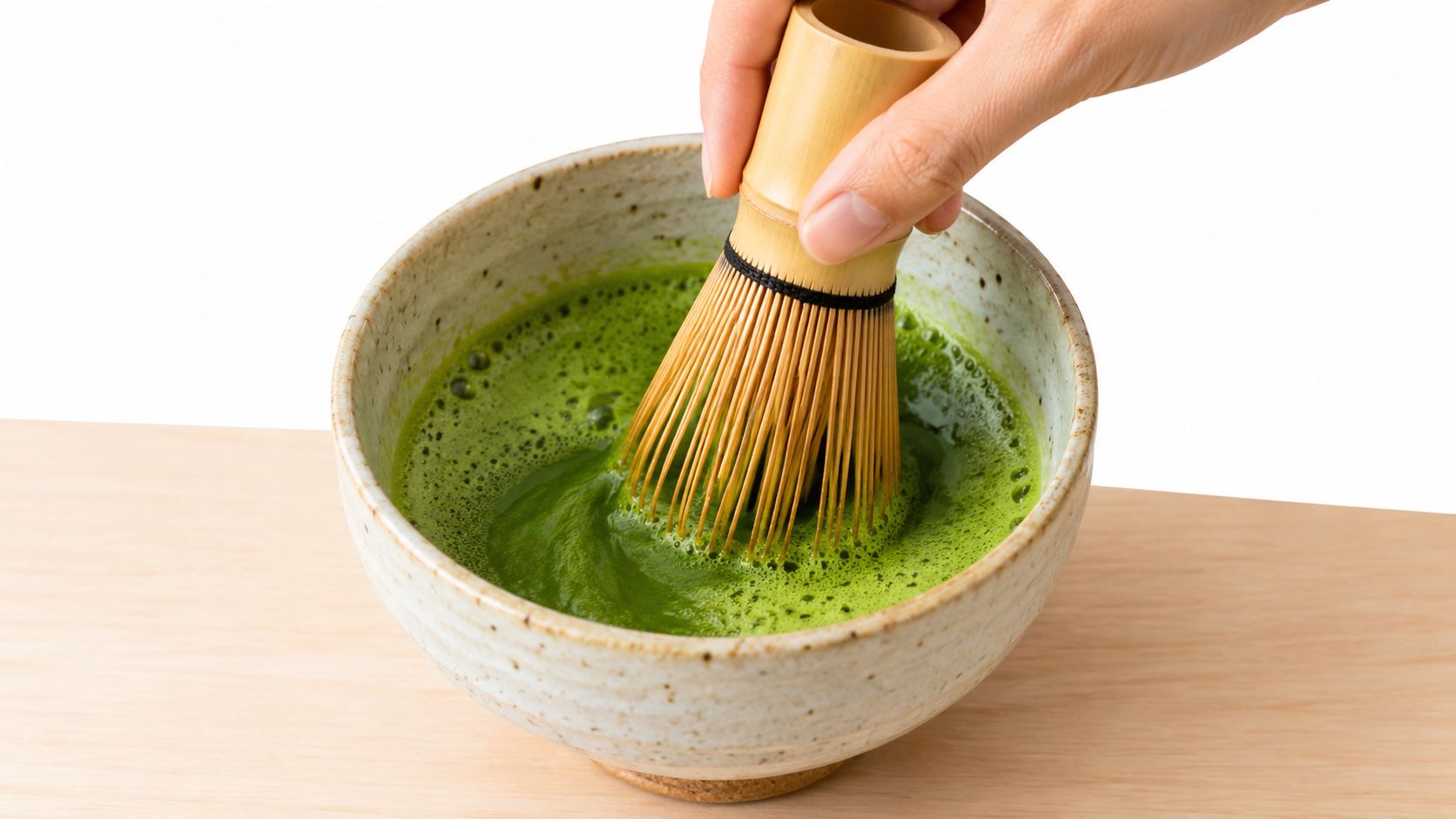
Wrist, not arm: The smaller and faster your controlled movement, the easier it is to create fine foam without damaging the bamboo.
If clumps remain, check the preparation rather than just whisking harder. Powder that wasn't sifted may need more time to disperse. Too little water can make the paste so thick that the tines cannot move freely, while a bowl that is too narrow limits the motion.
A fine hand sifter for matcha preparation helps prevent dry pockets before whisking begins. It won't replace the chasen, but it removes one common obstacle. The whisk then has to perform its proper job, creating suspension and foam instead of fighting large lumps.
Let the foam guide you. If you see a glossy, even surface with tiny bubbles, your movement is working. If the surface contains large bubbles and the bottom feels thick, keep the tines moving through the mixture rather than only skimming the top.
Caring for Your Bamboo Whisk to Extend Its Life
Bamboo changes when it gets wet. Before use, soften the tines in warm water so they can flex without unnecessary stress. This short preparation step also helps the whisk move smoothly through the bowl instead of catching sharply against the liquid.
After drinking, rinse the chasen promptly under warm running water. Rotate it gently so matcha residue leaves the inner and outer tines. Don't use detergent, and don't put the whisk in a dishwasher. Soap can remain in the bamboo, while heat and force can distort the fine prongs.
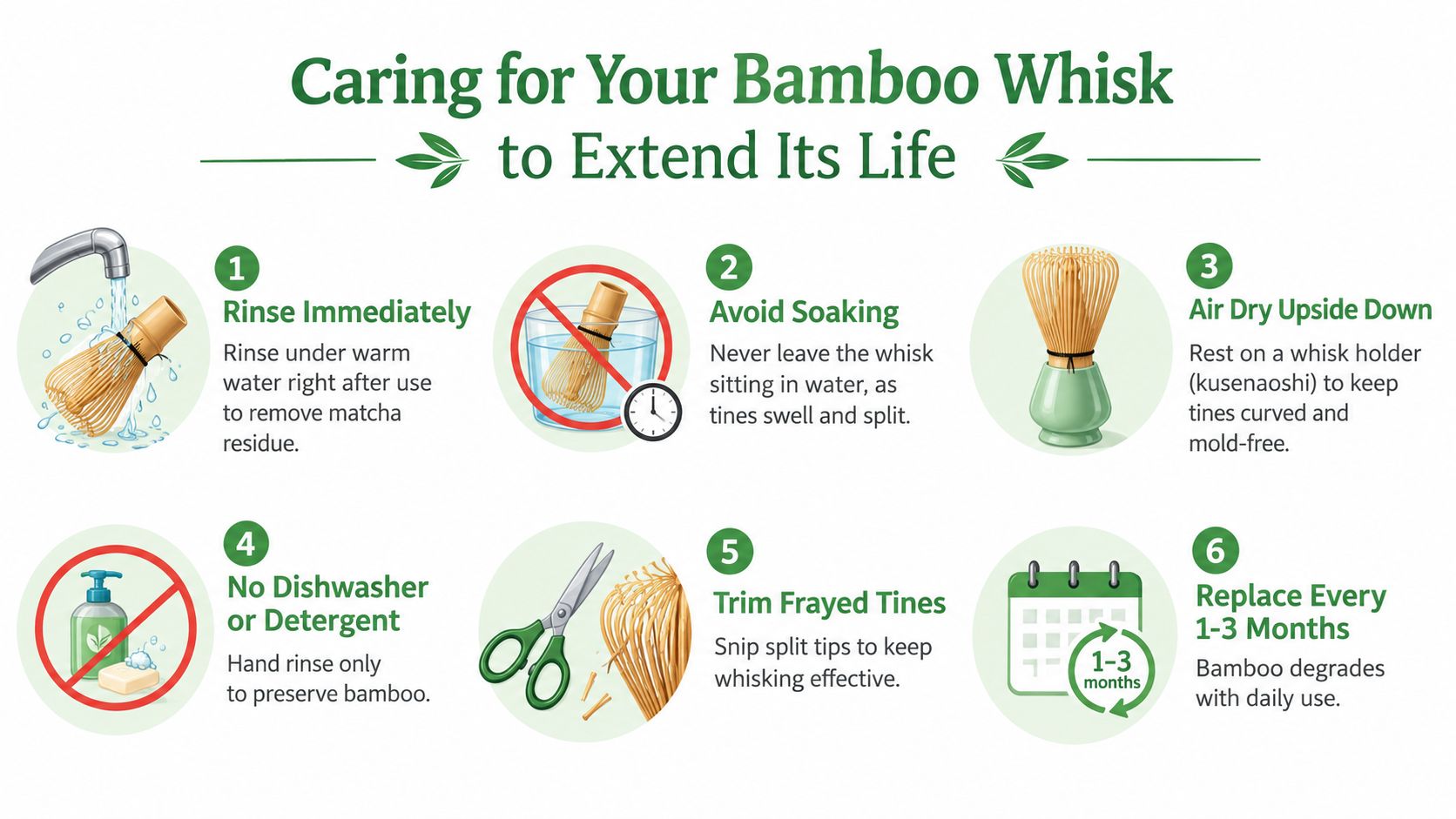
A simple care routine
- Soften before whisking: Warm water restores flexibility to the tines before they meet the powder.
- Rinse immediately: Remove residue while it's still wet rather than allowing matcha to dry between the prongs.
- Avoid prolonged soaking: Rinsing is useful, but leaving bamboo submerged can cause swelling and splitting.
- Air-dry completely: Place the chasen where air can circulate around it. A damp whisk stored in a closed cupboard is more likely to develop an unpleasant smell or mold.
- Use a holder: A holder supports the curved shape of the tines as the whisk dries. A matcha whisk holder also keeps the working end off the counter.
- Inspect regularly: Retire the whisk when many tines are frayed, split, or no longer spring back into position.
Care principle: Rinse thoroughly, dry fully, and never treat bamboo like a dishwasher-safe metal utensil.
Don't pull individual tines back into place after every use. That handling can create additional stress, especially when the bamboo is dry. Instead, let the holder support the natural shape while the whisk dries.
A few loose or slightly curved tines don't necessarily mean the chasen has failed. Pay attention to performance. If the whisk no longer disperses the powder evenly, sheds splinters, or feels rough against the bowl, replacement is sensible. A damaged chasen can make preparation harder and may leave bamboo fragments in the drink.
The included care video demonstrates the handling and cleaning routine visually:
Treat the whisk as a natural tea tool rather than a disposable stirrer. Gentle preparation before use and complete drying afterward protect both its shape and its ability to create the texture you want.
Exploring Electric and Alternative Frothing Tools
A bamboo chasen offers control, quiet focus, and a direct connection to the preparation. An electric whisk offers speed and consistency with less wrist work. Neither is automatically right for every drinker, because the better choice depends on whether you value ceremony, convenience, cleanup, or flexibility most.
Electric matcha whisks represent about 17.4% of the 2025 market, according to recent coverage of the matcha whisk market. The same coverage identifies speed and ease as important drivers, with household use remaining the largest application. That reflects a practical reality: many people want matcha at home, but not everyone wants a formal preparation each time.
Bamboo, electric, or hybrid
Bamboo works best when texture and ritual lead the decision. Its fine tines are designed for powdered tea, and the hand motion lets you adjust the intensity as the mixture changes. Cleanup is simple, but the tool needs careful rinsing and air-drying.
An electric whisk suits a faster routine. A battery-powered tool can disperse powder quickly and may be useful for lattes, especially when you're preparing a drink before work. Cleanup can be convenient, but the spinning head may create a different foam texture from a traditional chasen, and you'll need to prevent liquid from reaching the motor housing.
A handheld milk frother is a flexible compromise. It can mix matcha with water or milk and may already be in your kitchen. Use a sufficiently wide vessel and start gently to avoid splashing. It's practical, but it doesn't offer the same fine control over the surface motion as a bamboo chasen.
A hybrid routine often makes sense. Use bamboo when you have time to prepare usucha attentively, and choose an electric tool for a quick latte. The powder still benefits from sifting and an initial smooth mix, regardless of the tool. Convenience should change the method, not eliminate attention to texture.
Choose the tool you'll actually use. If the chasen encourages you to slow down and enjoy the bowl, it earns its place in your kitchen. If a rechargeable whisk helps you prepare matcha consistently on busy mornings, it may be the more realistic option. The perfect froth comes from matching the whisk's geometry and movement to the powder, then choosing a routine you can maintain.
Tealyra offers Japanese matcha powder and matcha accessories for building a practical home setup, including tools suited to whisking and sifting. Visit Tealyra to choose your powder and matcha whisk, then start with a sifted bowl, warm water, and a relaxed W-shaped motion.