 by Tealyra
English Breakfast or Earl Grey: 14–61 mg and Tealyra's Brewing Picks
Decide between English Breakfast and Earl Grey with lab-backed caffeine (14–61 mg), tested brew times, tasting notes, and Tealyra's recommended brews for...
English Breakfast is a full-bodied blend of black teas built for a milky morning cup, while Earl Grey is black tea scented with bergamot oil for a citrusy, aromatic sip best enjoyed without milk. If you want a bracing, malty base to start your day, reach for English Breakfast. If you crave floral citrus notes in your mug, Earl Grey is your match.
TL;DR:
- Both teas use black tea blends; caffeine levels vary more with brewing time and technique than the type of tea or blend.
- English Breakfast blends Assam, Ceylon, and Kenyan teas, prioritizing maltiness and full body, while Earl Grey is flavored primarily with bergamot oil or peel for aroma.
- Brew both teas at near boiling for 3 to 5 minutes, with steeping time and leaf amount more influencing caffeine and flavor than the blend itself.
- Milk pairs well with English Breakfast to soften its briskness, whereas adding milk to Earl Grey can mute its citrus aroma, which is better enjoyed plain or with lemon.
- Starting with small batch samples of each allows new drinkers to gauge their preferred flavor intensity and experiment side by side.
Table of Contents
- What Is English Breakfast Tea? Composition and Base Teas Explained
- What Is Earl Grey? Bergamot, Flavoring Methods, and Variations
- English Breakfast and Earl Grey Side by Side
- Tasting Notes and How to Compare Them Side by Side
- Caffeine Levels and What Actually Changes Them
- How to Brew Each Tea for a Reliable Cup
- Caffeine Sensitivity and Everyday Health Notes
- Which Should You Choose: Scenario Picks and a Quick Checklist
- How English Breakfast and Earl Grey Took Shape Over Time
- Regional Variations and Who Makes Them Well
- Cultural Significance and When People Reach for Each Cup
- What You’ll Pay and Where to Find Each Tea
- How Tealyra Chooses Its English Breakfast and Earl Grey
- Bring Both Teas Home: Where to Start
- Sources
- FAQ
What Is English Breakfast Tea? Composition and Base Teas Explained
English Breakfast isn’t a single tea plant or garden. It’s a blending concept, a combination of black teas chosen to produce a bold, brisk cup strong enough to stand up to milk and a hearty morning meal. The name describes the style and purpose rather than one fixed recipe, which is why two boxes labeled “English Breakfast” can taste noticeably different depending on which black teas went into the mix.
Most blends draw from three workhorse teas, each contributing a distinct trait:
- Assam brings deep malt sweetness and a thick, almost brothy body.
- Ceylon adds brightness and a brisk, slightly citrusy edge that cuts through milk.
- Kenyan teas contribute color and a punchy, no-nonsense strength that holds up in large batches.
Blenders combine these in varying ratios to hit a house style, so a Kenyan-heavy blend will taste sharper and more astringent than an Assam-forward one, which leans sweeter and rounder.
Format matters too. Loose-leaf versions generally preserve more of the leaf’s natural oils and give you control over strength, while teabags prioritize speed and convenience at some cost to nuance. Decaffeinated versions exist for anyone who wants the flavor profile without the caffeine jolt. When shopping, check the product description for the base teas listed and any origin notes. A blend that names its component teas (say, Assam and Ceylon) usually signals more transparency about what’s actually in your cup than one that simply says “black tea.”
What Is Earl Grey? Bergamot, Flavoring Methods, and Variations
Earl Grey starts as a black tea base, then gets scented or flavored with bergamot, a fragrant citrus fruit grown primarily for its essential oil rather than its juice. That oil, extracted from the peel, is what gives Earl Grey its signature lift of citrus and faint floral perfume, a world away from the straightforward maltiness of a breakfast blend.
How that bergamot gets onto the tea leaf varies by producer, and the method has a real effect on the final cup:
- Sprayed oil: natural or synthetic bergamot oil is applied directly to dried tea leaves, offering a fast, even flavor coating.
- Blended with bergamot peel: dried or candied peel pieces are mixed in with the leaves, delivering a more textured, slow-release aroma as you steep.
- Added flavoring or essence: a concentrated flavoring compound is used, which can taste more one-dimensional than true oil if quality is low.
Variations extend well beyond the classic black-tea version. Lady Grey softens the citrus with added orange peel and sometimes lavender or lemon. Green or oolong Earl Greys swap the black-tea base for a lighter one, muting the bergamot’s intensity and calling for gentler brewing. When judging quality from a product description, look for language naming actual bergamot oil or peel rather than vague “natural flavoring,” and check how bergamot is applied to tea leaves to understand why some cups smell faint while others practically perfume the room.
English Breakfast and Earl Grey Side by Side
Both teas typically start from the same black-tea foundation, which is exactly why the differences that remain matter so much. English Breakfast leans on blending skill to build body and malt. Earl Grey leans on bergamot to build aroma. Where they overlap is in strength and caffeine; where they diverge is in what hits your nose first; citrus perfume or toasty, brisk tea.
| Decision axis | English Breakfast | Earl Grey |
|---|---|---|
| Base tea | Blend of Assam, Ceylon, Kenyan black teas | Black tea (sometimes green or oolong) |
| Defining additive | None, relies on blend ratio | Bergamot oil, essence, or peel |
| Flavor snapshot | Malty, brisk, full-bodied | Citrusy, floral, aromatic |
| Typical caffeine range | Same black-tea band as Earl Grey | Same black-tea band as English Breakfast |
| Serving style | Often with milk and sugar | Often plain or with a twist of lemon |
| Best for | Hearty mornings, milk drinkers | Afternoon sipping, aromatic preference |
Brewed black teas, including both of these styles, typically contain roughly 14 to 61 milligrams of caffeine per 6-8 ounce serving, a wide range driven far more by brewing choices than by whether bergamot was added. That single fact reframes the whole comparison: picking between these two is mostly a flavor decision, not a caffeine one.
A few quick takeaways follow from that overlap:
- Neither tea is inherently stronger in caffeine; brewing technique moves the needle more than blend identity.
- The real contrast is sensory, malt and body against citrus and perfume.
- Milk drinkers tend to gravitate toward English Breakfast because its body doesn’t disappear under cream.
Tasting Notes and How to Compare Them Side by Side
English Breakfast opens with a toasty, malty aroma and a medium to full body that carries through to a brisk, sometimes tannic finish, especially if Kenyan tea dominates the blend. It’s a tea built to be tasted through milk, which softens the astringency without erasing the malt.
Earl Grey announces itself differently. The first note is citrus, sharp and floral, riding on top of whatever black tea sits underneath. A high-quality bergamot oil gives a lingering, almost perfumed finish, while a weaker flavoring fades fast and leaves the base tea’s plainer character exposed. The strength of the underlying black tea also shapes how the bergamot reads: a robust Assam base can wrestle with the citrus for attention, while a lighter Ceylon or Chinese black tea lets the bergamot shine unchallenged.
To compare them properly, brew both in the same session using identical water, leaf weight, and steep time. Taste the English Breakfast first to calibrate your sense of malt and body, then move to the Earl Grey to isolate the citrus top note. Doing this side by side, rather than days apart, makes the contrast obvious in a way memory alone won’t.
- Pair English Breakfast with buttered toast, bacon, or anything rich enough to meet its body.
- Pair Earl Grey with lemon cake, shortbread, or light pastries that won’t fight its citrus.
- Add milk to English Breakfast freely, but go easy with Earl Grey since dairy can mute bergamot’s aromatic lift.
Pro Tip: Taste Earl Grey without milk first. Once you know what the bergamot alone tastes like, you can decide if you want to dial it back with a splash of cream.
Caffeine Levels and What Actually Changes Them
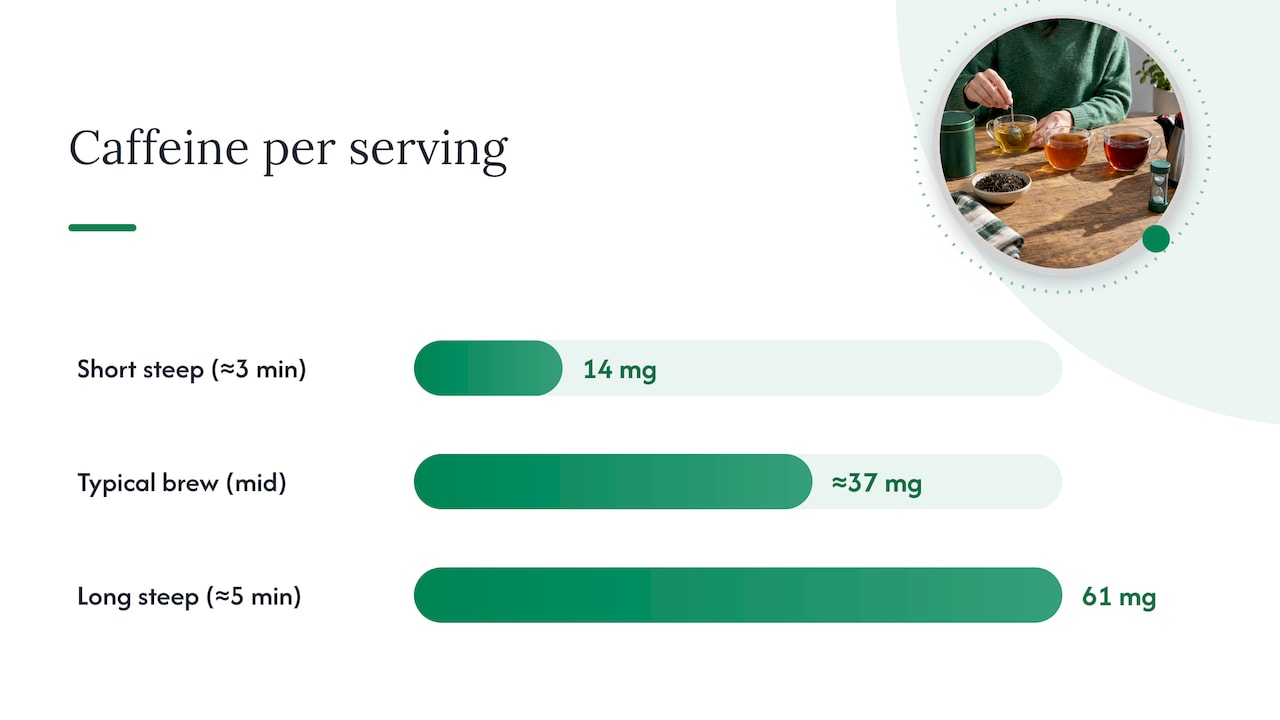
Caffeine in both teas sits within the same broad band because they share a black-tea foundation. Laboratory analysis of brewed teas found caffeine levels ranging from about 14 to 61 milligrams per serving, with steep time shown to meaningfully shift the concentration within that range. Decaffeinated versions of either tea contain low caffeine levels, generally recognized as minimal compared to regular brewed teas.
What actually pushes your cup toward the high or low end of that range has little to do with whether you chose English Breakfast or Earl Grey and everything to do with how you brew:
- Steep time: a longer steep pulls more caffeine out of the leaf, along with more tannins and bitterness.
- Water temperature: hotter water extracts faster, so near-boiling water draws out caffeine more quickly than lukewarm water.
- Leaf amount: more leaf per cup means more available caffeine to extract.
- Serving size: a larger cup simply contains more of whatever concentration you brewed.
If you want less caffeine, shorten your steep by a minute or switch to a decaf blend. If you want more kick, use slightly more leaf and steep closer to the five-minute mark rather than three. For more detail on how caffeine varies across tea types, brewing method consistently matters more than the specific blend name on the box.
How to Brew Each Tea for a Reliable Cup
Getting a consistent cup comes down to temperature, timing, and leaf amount, and the two teas respond a little differently to each.
- Heat water to near boiling, around 200 to 212 degrees Fahrenheit, for both English Breakfast and Earl Grey since both use a black-tea base that needs higher heat to unlock flavor.
- Use about one teaspoon of loose leaf per 8-ounce cup, adjusting upward slightly if you prefer a stronger brew.
- Steep English Breakfast for 3 to 5 minutes to develop full malt and body without tipping into harsh astringency.
- Steep Earl Grey for 3 to 4 minutes, erring toward the shorter end if you want the bergamot’s top notes to stay bright rather than getting buried under bitterness.
- Strain promptly once steeping ends so the leaves stop releasing tannins into the cup.
For iced versions, a cold-brew method works well for both: steep about one tablespoon of leaf per quart of cold water in the refrigerator for 6 to 8 hours, which tends to pull less caffeine than a hot steep of the same duration while keeping the flavor smooth.
Milk works beautifully with English Breakfast, rounding out its brisk edges. With Earl Grey, add milk sparingly, since dairy proteins can bind with and mute the bergamot aroma that makes the tea distinctive. A thin slice of lemon, by contrast, tends to brighten Earl Grey rather than compete with it.
Pro Tip: If your Earl Grey tastes flat, you likely oversteeped it or started with a weak bergamot application. Shorten the steep next time and check the ingredient description before buying again.
The most common mistakes are oversteeping English Breakfast into bitterness and understeeping Earl Grey so the bergamot never fully opens up.
Caffeine Sensitivity and Everyday Health Notes
Black tea, the shared base of both these styles, carries polyphenol antioxidants along with its caffeine, and that caffeine can sharpen alertness during the day while disrupting sleep if consumed too late. If you’re sensitive to caffeine, the brewing adjustments already covered, shorter steeps, less leaf, or a decaf version, give you real control without giving up the flavor you like.
- Keep afternoon and evening cups shorter in steep time or switch to decaf to protect sleep quality.
- Reduce leaf quantity or cup size if you notice jitteriness rather than alertness.
- Watch for rare fragrance sensitivities to bergamot, since the essential oil can occasionally trigger a mild reaction in people sensitive to citrus compounds; discontinue use if you notice irritation.
- Talk to a healthcare provider about caffeine intake if you’re pregnant, nursing, or taking medications that interact with caffeine.
Neither tea carries unusual risk for a typical healthy adult in normal serving sizes. The guidance above is about fine-tuning comfort, not avoiding a hazard.
Which Should You Choose: Scenario Picks and a Quick Checklist
The fastest way to decide is to picture the moment you’ll actually be drinking it. A busy weekday morning with milk and toast calls for English Breakfast’s body. A slower afternoon break, especially with something sweet, suits Earl Grey’s aromatic lift. Dessert pairings favor Earl Grey almost every time, since its citrus plays well against sugar. If milk is non-negotiable in your routine, English Breakfast will hold its character better under cream than Earl Grey will.
Run through three questions when you’re stuck between the two:
- Do you want milk in your cup? If yes, lean English Breakfast.
- Do you want citrus aroma over malt? If yes, lean Earl Grey.
- Do you need maximum body and strength? If yes, English Breakfast wins.
For beginners building a first tea routine, English Breakfast is the safer starting point because its flavor is familiar and forgiving of minor brewing errors. Daily drinkers who already know they love aromatic teas will find Earl Grey a reliable afternoon ritual that rarely gets old.
How English Breakfast and Earl Grey Took Shape Over Time
English Breakfast emerged in the 19th century as a blending tradition rather than a single origin story, developed to produce a tea strong enough to accompany a substantial morning meal and stand up to milk, a staple of the era’s domestic routine. Blenders experimented with Assam, Ceylon, and other black teas to hit a consistent, robust profile that could be reproduced at scale, which is why the name describes a style rather than a fixed garden or harvest.
Earl Grey’s history is murkier and often tangled with legend, most commonly tied to Charles Grey, the 2nd Earl Grey and a British prime minister in the early 19th century, who is said to have received a gift of bergamot-scented tea that later carried his name. Whether that specific story is fact or embellishment, bergamot-flavored black tea became a recognized category by the mid-1800s and has remained a fixture of British tea culture since.
Both styles evolved alongside the broader expansion of tea importing and blending as a commercial craft, moving from aristocratic novelty to everyday pantry staples over the following century. Today’s versions, loose-leaf, bagged, decaffeinated, and flavored variants, reflect that long evolution from a single blend concept into an entire category of styles built on the same foundation.
Regional Variations and Who Makes Them Well
English Breakfast and Earl Grey are made worldwide now, but regional habits still shape how each is typically served and sourced. British households often favor a strong, milk-forward English Breakfast as a daily staple, while tea drinkers elsewhere may prefer a lighter steep or a blend leaning more heavily on Ceylon for brightness rather than Assam’s malt.
Earl Grey sees its own regional spins. French producers sometimes pair bergamot with additional floral notes, while some blenders in warmer climates favor a lighter black tea base that lets the citrus dominate without competing against a heavy malt backbone. Green and oolong Earl Grey variants, more common in some Asian tea traditions, swap the robust black base for something gentler, changing both the aroma and the ideal brewing temperature.
Because both styles are really blending concepts rather than single-origin teas, the base tea’s provenance (Assam versus Ceylon versus Kenyan, or the quality of the bergamot oil used) matters more to the final cup than any single country’s claim on the recipe. That’s part of why product descriptions matter so much: two teas labeled identically can taste quite different depending on where their components were grown and how they were blended.
Cultural Significance and When People Reach for Each Cup
English Breakfast earned its name by being woven into a daily ritual, the morning meal, and it still carries that association strongly. It’s the cup people reach for alongside eggs and toast, a dependable, no-frills companion to starting the day rather than a tea chosen for ceremony or occasion.
Earl Grey carries a slightly different cultural weight. Its association with British refinement and literary or period-drama imagery has made it something of a shorthand for elegance, often served in the afternoon or alongside a lighter social gathering rather than a rushed breakfast. It shows up at afternoon tea service, paired with scones or pastries, more often than it shows up at the breakfast table.
Neither tea is bound strictly to its traditional occasion today. Plenty of people drink Earl Grey first thing in the morning and English Breakfast all afternoon. But the cultural pull remains useful shorthand: if you’re setting a mood of comfort and routine, English Breakfast fits. If you’re setting a mood of occasion or a touch of indulgence, Earl Grey tends to suit the moment better.
What You’ll Pay and Where to Find Each Tea
Both English Breakfast and Earl Grey span a wide price range depending on format and quality. Basic teabag versions from grocery store shelves sit at the most affordable end, prioritizing convenience over nuance. Loose-leaf versions, particularly those naming specific base teas like Assam or Ceylon, or using genuine bergamot oil rather than synthetic flavoring, tend to cost more per ounce but deliver a noticeably fuller cup.
Availability is broad for both. English Breakfast is close to universal in grocery stores, cafés, and specialty shops alike, since it functions as a default “black tea” option in much of the English-speaking world. Earl Grey is nearly as widespread but shows more variation in quality at the lower price tiers, since cheap synthetic bergamot flavoring is common in mass-market versions, while naturally flavored, higher-quality versions usually require shopping at a specialty retailer rather than a general grocery aisle.
If you’re comparing two products at similar prices, check the ingredient list rather than the price tag alone. A loose-leaf English Breakfast that names its component teas, or an Earl Grey that specifies real bergamot oil, usually signals a more carefully sourced product than one with vague labeling, regardless of where it sits on the price spectrum.
How Tealyra Chooses Its English Breakfast and Earl Grey
A large catalog of loose teas exists because selection, not just sourcing, is the real work. For English Breakfast, that means evaluating base-tea provenance and blend balance so the malt and brightness actually come through. For Earl Grey, it means checking bergamot quality and application method so the citrus aroma doesn’t fade into a flat, generic flavoring. The goal across both is an authentic cup that tastes like what the label promises, not a shortcut version of it.
— Tealyra
Bring Both Teas Home: Where to Start
Choosing between English Breakfast and Earl Grey doesn’t have to mean picking just one. A wide loose-leaf selection makes it easy to try both without guessing at quality, and free shipping over a threshold can make building out a starter collection practical rather than a splurge.
If you’re new to loose-leaf tea, consider starting small:
- A sample size of English Breakfast lets you test whether a malt-forward blend suits your morning routine before committing to a larger bag.
- A sample size of Earl Grey lets you gauge bergamot intensity, since preferences for citrus strength vary widely.
- Pairing both in one order gives you a direct side-by-side comparison using your own kettle and your own taste.
Browse the full loose leaf tea selection to find the base teas and bergamot blends that match what you’re after, and build a cup that fits your actual morning, not just a label.
FAQ
Which tea has more caffeine, English Breakfast or Earl Grey?
Neither tea is reliably stronger in caffeine since both typically use a black-tea base. Laboratory testing found brewed black teas ranging from about 14 to 61 milligrams per serving, with steep time affecting the result more than the blend’s name.
Can I add milk to Earl Grey the same way I do English Breakfast?
You can, but milk tends to mute bergamot’s aroma, which is the main reason people drink Earl Grey in the first place. Many drinkers prefer Earl Grey plain or with a touch of lemon instead, saving milk for English Breakfast’s heartier body.
Is English Breakfast or Earl Grey better for beginners?
English Breakfast is generally the easier starting point since its malty, familiar flavor forgives small brewing mistakes and pairs predictably with milk. Earl Grey rewards a bit more attention to steep time to keep its bergamot notes from fading or turning bitter.
What’s the best water temperature and steep time for these teas?
Both do well with water heated to roughly 200 to 212 degrees Fahrenheit. English Breakfast typically steeps for 3 to 5 minutes for full body, while Earl Grey is often better at 3 to 4 minutes to protect its citrus top notes.
Does Tealyra offer both English Breakfast and Earl Grey in loose-leaf form?
Various catalogs of loose teas can include both styles, selected for base-tea quality and bergamot authenticity. Free shipping over a certain amount often makes it easy to try both in one order.