 by Tealyra
Smooth Cold Brew Tea in 4–10 Hours: Recipes, Ratios, What to Buy
Make smoother iced tea at home with cafe tested recipes, 4–10 hour fridge steeps, exact ratios, and shopping picks for whole-leaf and herbal blends.
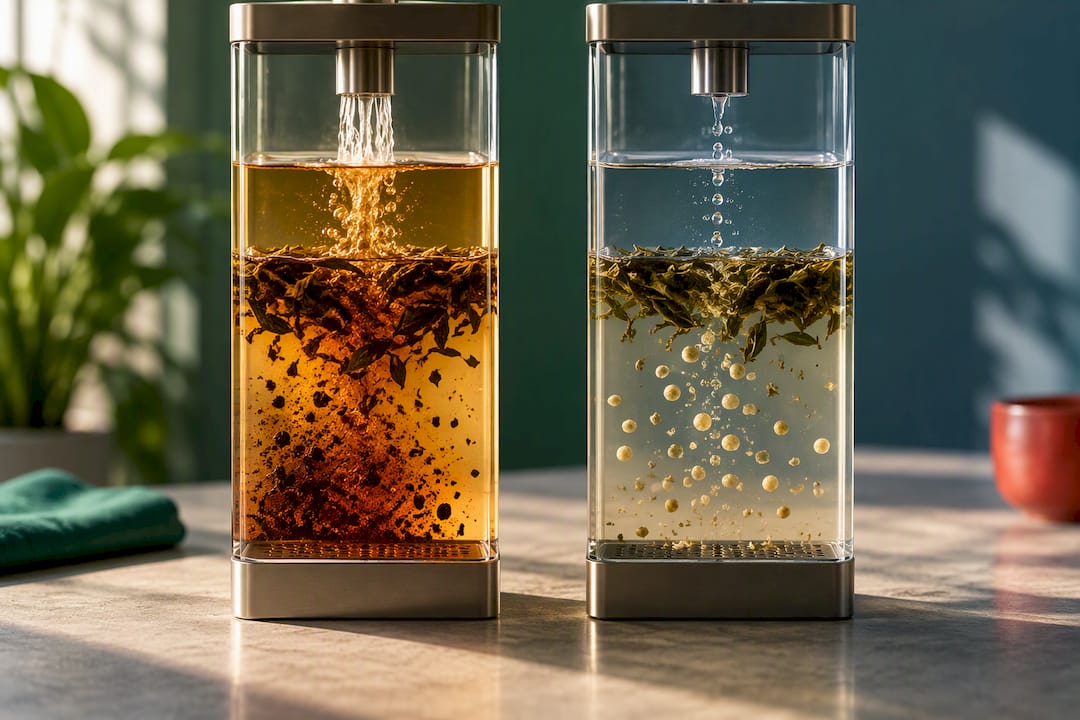
Cold brew tea is loose leaf or bagged tea steeped in cold water for hours instead of hot water for minutes. The fastest reliable method: add your tea to cold water, seal the container, refrigerate for 4 to 10 hours, then strain. The payoff is a rounder, sweeter cup with noticeably less bitterness, and usually a lighter caffeine hit than a hot-brewed equivalent.
TL;DR:
Cold brew tea benefits from using whole-leaf teas like high-mountain oolongs or white teas, which steep more smoothly over 6 to 8 hours at fridge temperatures.
Using double the typical leaf amount creates a concentrate that can be diluted quickly, reducing daily steeping time.
The ideal steeping window in the fridge is 6 to 8 hours for delicate teas, while black teas require closer to 6 to 10 hours and lower leaf ratios to prevent bitterness.
Over-steeping or using broken/CTC teas increases the risk of bitterness, so adjusting leaf ratio and steep time is crucial for flavor control.
Cold brew tea stored in a sealed container remains fresh and flavorful for up to 72 hours, but flavor degradation begins beyond that period even if it does not spoil.
Table of Contents
How Do You Make Cold Brew Tea at Home?
The basic ratio that works across most kitchens is 1 gram of loose tea per 100 milliliters of cold water. No scale? Use 1 rounded teaspoon of loose tea, or 1 tea bag, per cup of water, which lines up with the ratios Serious Eats recommends after years of recipe testing: roughly 1 bag per cup, or about 4 bags per quart.
Basic fridge batch:
-
Add loose tea or bags to a pitcher of cold, filtered water.
-
Cover and refrigerate for 6 to 8 hours (green and white teas) or up to 10 hours (black tea, lower ratio).
-
Strain through a fine mesh strainer or remove the bags.
-
Serve over ice as is, or sweeten to taste.
Cold-brew concentrate works well if you drink iced tea daily. Use double the standard ratio, roughly 2 grams per 100 milliliters, steep the same window, then dilute the concentrate 1:1 with water or ice when you pour a glass. The concentrate keeps in a sealed jar and lets you make a fresh glass in seconds without re-steeping every day.
Two easy variations to try:
-
Berry mint cold brew: add a handful of crushed berries and a few mint leaves to a black or oolong base before refrigerating.
-
Green tea with lemon: steep green tea for 6 hours, then add fresh lemon slices in the last hour so the citrus doesn’t turn the brew bitter.
Pro Tip: Strain into a clean container as soon as the steep time is up. Leaving leaves in the pitcher, even in the fridge, keeps extracting tannins and will slowly push a clean batch toward bitterness.
Which Teas Work Best for Iced Tea?
Leaf size changes everything about how a tea behaves in cold water. Whole-leaf, orthodox-style teas release their flavor slowly and evenly, which makes them forgiving for long overnight steeps. Broken leaf or CTC (cut, torn, curled) grades have far more surface area exposed to water, so they extract faster and can turn harsh if you treat them like whole leaf.
Rough ratio and time ranges by tea family:
-
Green tea for iced tea: 1 g per 100 ml, 4 to 6 hours. Delicate and quick to extract.
-
White tea: 1 to 1.5 g per 100 ml, 6 to 8 hours. Naturally sweet with low bitterness risk.
-
Oolong: 1.5 g per 100 ml, 6 to 8 hours, longer for high-mountain styles with tightly rolled leaves.
-
Black tea for iced tea: 0.75 to 1 g per 100 ml, 6 to 10 hours depending on grade. Broken grades lean toward the shorter end.
-
Herbal and fruit blends: no caffeine ceiling to worry about, so 1.5 to 2 g per 100 ml for 4 to 8 hours works for most bold flavors.
In household terms, 1 gram of loose leaf tea is roughly 1 rounded teaspoon, or one standard tea bag. If a batch tastes weak, add more leaf before you add more time. When you’re shopping for loose leaf tea for iced tea, check the product page for leaf grade (whole leaf vs. broken) and tasting notes. That’s usually enough to predict how it will behave over a long cold steep.
Why Does Cold Brew Tea Taste Smoother Than Hot Tea?
Hot water pulls everything out of tea leaves fast, including the catechins and tannins responsible for bitterness and dryness. Cold water is choosier. Amino acids and sugars, the compounds behind sweetness and body, dissolve readily even in cold water. Catechins, some tannins, and caffeine need heat and time to release in volume, so a cold, slow steep leaves more of the sweet stuff and less of the harsh stuff in your glass.

A study on cold-brewed Fuding white tea found that cold extraction produced a fresher, sweeter infusion with lower caffeine dissolution than a hot-brewed control, confirming that this isn’t just a taste illusion. Separate research on hot versus cold extraction found cold infusion can extract certain antioxidant compounds just as efficiently as hot water, even while pulling less caffeine and fewer harsh tannins.
Time and temperature work together exponentially, not in a straight line. A few extra hours at refrigerator temperature (around 39 to 43°F) rarely ruins a batch. The same extra hours at room temperature can push it into bitter territory fast, especially with black tea.
-
Fridge temperature buys you a wider, safer steeping window.
-
Room temperature speeds up extraction of everything, good and bad, at once.
-
Black tea has the least room for error. Keep it in the lower ratio range and don’t drift past 10 hours.
Why Is My Cold Brew Bitter or Weak?
-
Bitter or metallically sharp: you likely over-steeped, used too much leaf, or brewed a broken-grade tea like whole leaf. Cut the ratio, shorten the time, or switch to a whole-leaf grade next time.
-
Weak or watery: brew a concentrate and dilute less, or switch to a smaller leaf size that extracts faster within the same window.
-
Cloudy tea: this is usually just cold-water precipitation of natural compounds, not a spoilage sign, but filtered water and a fine mesh strainer minimize it.
-
Off flavors: rinse the container thoroughly between batches and avoid plastic pitchers that hold onto old aromas.
Pro Tip: Set a phone timer the moment you put the pitcher in the fridge. The single biggest cause of bitter cold brew is simply forgetting about it for 18 hours instead of 8.
How Long Does Cold Brew Tea Last in the Fridge?
Cold brew tea tastes best within 48 to 72 hours of straining. Flavor fades and can turn stale or flat beyond that window, even though the tea won’t necessarily spoil right away.
Refrigeration isn’t just about taste. Sun tea, steeped on a counter or windowsill at warm room temperature, sits in the exact range that lets bacteria multiply, which is why Serious Eats and most food-safety guidance recommend the fridge instead. Cold, consistent temperatures control both safety and flavor at once.
-
Store strained tea in a sealed glass pitcher or jar, not the original steeping vessel.
-
Reheat gently on the stove or in short microwave bursts if you want a hot cup. Avoid a hard-boil, which can bring back bitterness.
-
Don’t reuse cold-brewed leaves for a second batch. Most of their flavor is already gone.
-
Add sugar, honey, or simple syrup after straining, and stir sweetened batches well since sugar settles fast in a cold pitcher.
Which Tealyra Teas Work Best for Cold Brew?
Cold brew rewards teas with delicate, layered flavor that hot water can sometimes flatten. High-mountain oolongs hold onto their floral aromatics remarkably well over a long cold steep, and white teas bring natural sweetness with very little bitterness risk. Whole-leaf black teas, brewed at a lighter ratio, give you the classic iced tea profile without the harsh edge that broken grades can produce. Tealyra’s fruit and herbal blends are also solid picks since they have no caffeine ceiling to manage and forgive a slightly longer steep.
When you’re browsing, look for leaf grade and tasting notes on the product page. A whole-leaf listing with notes like “sweet” or “floral” is a strong cold-brew candidate; a broken or dust-grade listing will need a shorter, gentler treatment.
-
High-mountain oolong: aromatic, forgiving over 6 to 8 hours.
-
White tea: naturally sweet, low bitterness risk.
-
Whole-leaf black tea: classic iced tea flavor at a lighter ratio.
-
Fruit and herbal blends: caffeine-free and flexible on timing.
If you’re brewing for the week, batch a larger quantity of concentrate and order enough to cover it. Tealyra offers free shipping on orders over $55, which makes stocking up on a few cold-brew-friendly varieties an easy call.
When Should You Actually Cold Brew Instead of Hot Brew?
Cold brew earns its place as a daily, make-ahead routine. It rewards patience with a smoother, sweeter glass and fits naturally into a weekly rhythm: steep a pitcher before bed, strain it in the morning, and drink from it for two or three days. Hot brewing still wins when you want a strong cup right now, or when a tea’s flavor genuinely needs heat to open up fully. Try batching one pitcher on a Sunday night as a low-effort way to build the habit.
— Tealyra
Stock Your Pantry for Cold Brew Season
A broad selection of loose leaf teas means you’re never stuck picking from three generic black tea options when you want a whole-leaf oolong or a delicate white tea suited to a long cold steep.

If you’re new to cold brewing, start with a small sampling of a high-mountain oolong, a white tea, and a whole-leaf black tea to compare how each performs in your fridge over a week. Free shipping is often offered on larger orders, so it’s worth building a batch-ready pantry in one order. Browse loose leaf tea options and pick a few varieties to start your next pitcher tonight.
Sources
-
Study on the Extraction Patterns of Key Quality Components in Cold-brewed Fuding White Tea
-
Evaluation of hot and cold extraction of bioactive compounds in teas
-
The Best Iced Tea (Cold-Brewed Iced Tea) Recipe — Serious Eats
FAQ
Is It Okay to Cold Brew Tea?
Yes, cold brewing is a safe and well-established method as long as you refrigerate rather than leave it at room temperature. Refrigeration keeps the tea in a temperature range that discourages bacterial growth, which is why Serious Eats and other food-science sources recommend it over sun tea.
What Is the Point of Cold Brew Tea?
Cold brewing produces a smoother, sweeter cup with less bitterness because cold water extracts fewer harsh tannins and catechins than hot water. It also tends to pull less caffeine, as shown in research on cold-brewed white tea, making it a gentler all-day sipper.
Is Cold Brew Tea the Same as Iced Tea?
Not exactly. Iced tea can be made by brewing hot and pouring over ice, while cold brew tea skips heat entirely and steeps in cold water from the start. Cold brewing is simply one method for making iced tea, and generally the one that produces the smoothest result.
How Do You Make Cold Brew Tea?
Add loose tea or tea bags to cold water at roughly 1 teaspoon or 1 bag per cup, cover, and refrigerate for 4 to 10 hours depending on the tea type. Strain, then serve over ice or dilute if you brewed a concentrate.